When Matovu Muhudi watched his mother develop Chronic Obstructive Pulmonary Disease (COPD) after years of cooking over smoky traditional stoves, he realised the problem extended far beyond his own family.
As a medical professional, he had spent years treating illnesses linked to household air pollution. But after seeing his mother’s condition, he decided to focus on preventing the diseases instead of simply treating them.
That decision led to the creation of Elsmart Conservation Technologies, a clean energy company that is emerging as one of western Uganda’s leading manufacturers of improved cookstoves and biomass briquettes.
Founded in March 2020, the company is based in Nyakaizi in Mbarara City South. It combines healthcare, environmental conservation, and manufacturing to tackle one of Uganda’s biggest public health challenges: household air pollution.
“My mother’s illness changed everything,” Muhudi says. “I wanted to provide ordinary Ugandans with cooking technologies that protect their health while remaining affordable.”
Today, Elsmart manufactures energy-efficient biomass cookstoves using recycled scrap metal. It also produces clean-burning briquettes from agricultural waste that would otherwise be thrown away.
The products give households and businesses a cleaner alternative to charcoal and firewood while reducing pressure on Uganda’s forests.
The company’s growth accelerated after it joined the Uganda National Alliance on Clean Cooking (UNACC) and participated in the Results-Based Financing (RBF) programme implemented by GIZ EnDev in partnership with Equity Bank Uganda.
“Results-Based Financing is not about promises,” says Virginia Semakula, Equity Bank’s Head of the Energy, Environment and Climate Change Pillar.
“The systems must first be installed, operational, and verified by an independent third party before incentives are paid.”
She says the bank has implemented several RBF programmes with partners such as GIZ EnDev to support the expansion of solar energy and improved cooking technologies in underserved communities.
Under the programme, Elsmart received performance-based incentives to manufacture and distribute improved cooking technologies.
The company was expected to supply 600 household cookstoves and 213 commercial cookstoves for restaurants and other businesses.
Muhudi not only met those targets but also used the opportunity to transform his business.
“The programme gave us confidence to invest in mechanised production,” he says. “Before then, we were operating on a very small scale.”
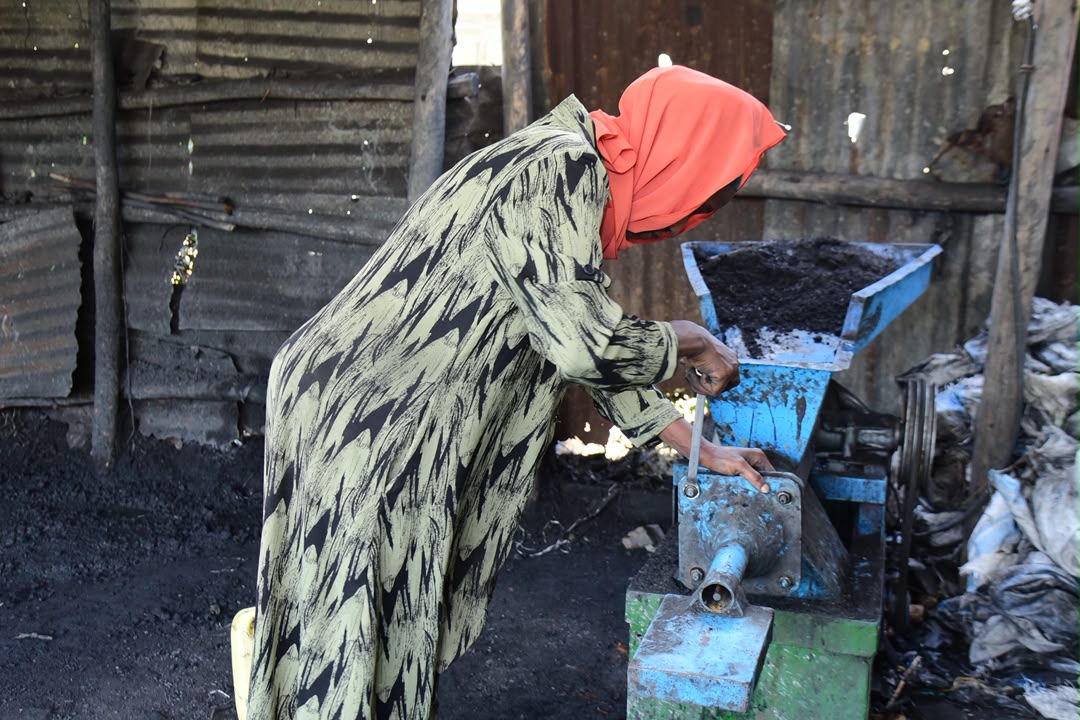
The investment enabled Elsmart to move from mainly manual production to mechanised manufacturing. The company can now produce both honeycomb and stick biomass briquettes more efficiently.
The expansion significantly increased production capacity while improving product quality and consistency.
As production increased, annual turnover rose from about Shs72 million to Shs98 million. The additional income enabled the company to expand production, diversify its products, and strengthen its presence across western Uganda.
One of Elsmart’s biggest innovations during the programme was the introduction of biomass briquettes selling at Shs1,500 per kilogramme.
Designed for use with improved cookstoves, the briquettes provide households with an affordable alternative to ordinary charcoal while producing far less smoke.
For Muhudi, however, growing the business is only part of the mission.
“We are trying to eliminate diseases caused by smoke while protecting the environment,” he says.
Despite increasing awareness about clean cooking, Muhudi says the company still faces stiff competition from traditional cooking technologies.
“The uptake of improved stoves is still low because traditional stoves are cheaper,” he explains.
“Some households can buy a traditional stove for as little as Shs8,000. Naturally, many people choose the cheapest option.”
Although Elsmart’s contract required it to distribute 600 household cookstoves, Muhudi set an internal target of selling 2,000 units.
By the end of the programme, the company had sold 1,200 stoves. This was double the contractual target, although it fell short of the company’s own ambition.
Muhudi believes wider adoption of improved cookstoves will require continued financing programmes that make modern cooking technologies more affordable for households and businesses.
He also wants the Uganda National Bureau of Standards (UNBS) to strengthen product certification.
“Poor-quality stoves are flooding the market,” he says.
“Better quality control will increase consumer confidence and improve the reputation of the industry.”
The Results-Based Financing programme also changed how Elsmart manages its customers.
Because every installation had to be independently verified, the company was required to keep detailed customer records and sales data.
What first seemed like an administrative requirement has since become an important business tool.
Elsmart now follows up with customers after every sale, monitors how the stoves perform, and quickly responds whenever users experience challenges.
Muhudi says this approach has improved customer satisfaction while creating a growing network of loyal customers who recommend the products to others.
For Alapha Nakayima, an Elsmart employee and former USAID health worker, the company’s products are as much about preventing disease as they are about providing clean energy.
“I joined Elsmart because I understood the health benefits,” she says.
“There has been an increase in respiratory illnesses caused by prolonged exposure to smoke from traditional cooking. These improved stoves greatly reduce smoke and help families live healthier lives.”
Nakayima uses the products in her own home and encourages her neighbours to adopt cleaner cooking technologies.
Beyond improving public health, Elsmart’s products also contribute to environmental conservation.
By turning agricultural waste into biomass briquettes, the company reduces dependence on charcoal, slows deforestation, and lowers carbon emissions.
The improved cookstoves also use less fuel while producing much less smoke and soot.
Looking ahead, Elsmart plans to fully automate its production line and establish distribution hubs in Isingiro, Ntungamo, Rukungiri, and Ishaka.
The company also plans to strengthen partnerships with organisations such as Renewable Hub and Hub Energy while preparing to enter the carbon credit market.
Muhudi hopes carbon credits will provide an additional source of revenue from the environmental benefits created by the company’s clean cooking technologies.
For a business inspired by one family’s painful experience with smoke-related illness, Elsmart has grown into something much bigger.
It is now demonstrating that locally developed clean cooking technologies can improve public health, protect the environment, and create sustainable businesses at the same time.