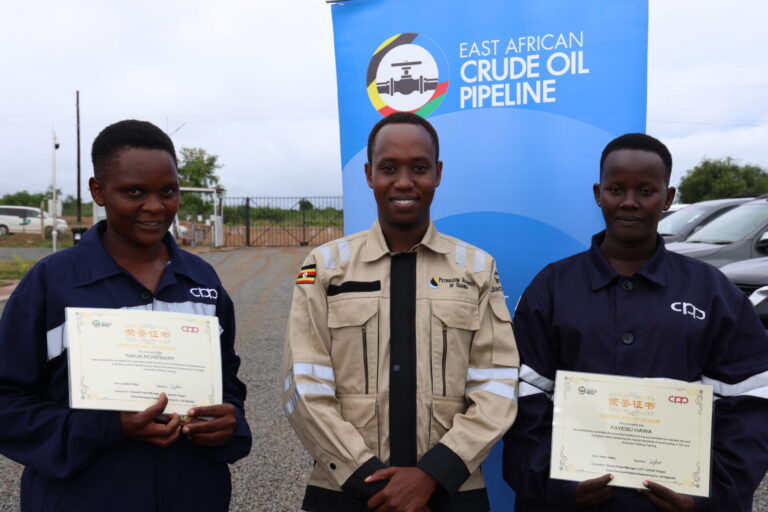
Twenty Ugandan workers involved in the construction of the East African Crude Oil Pipeline (EACOP) have completed more than 360 hours of specialised training, earning professional certifications that could open opportunities beyond the oil and gas industry.
The workers received their certificates at a ceremony organised by EACOP and its Tier 1 contractor, China Petroleum Pipeline Engineering Company Limited (CPP).
Ten of the graduates obtained the NEBOSH International General Certificate in Occupational Health and Safety, while another 10 were certified in Non-Destructive Testing (NDT), a method used to inspect pipelines and other critical infrastructure without damaging the equipment being examined.
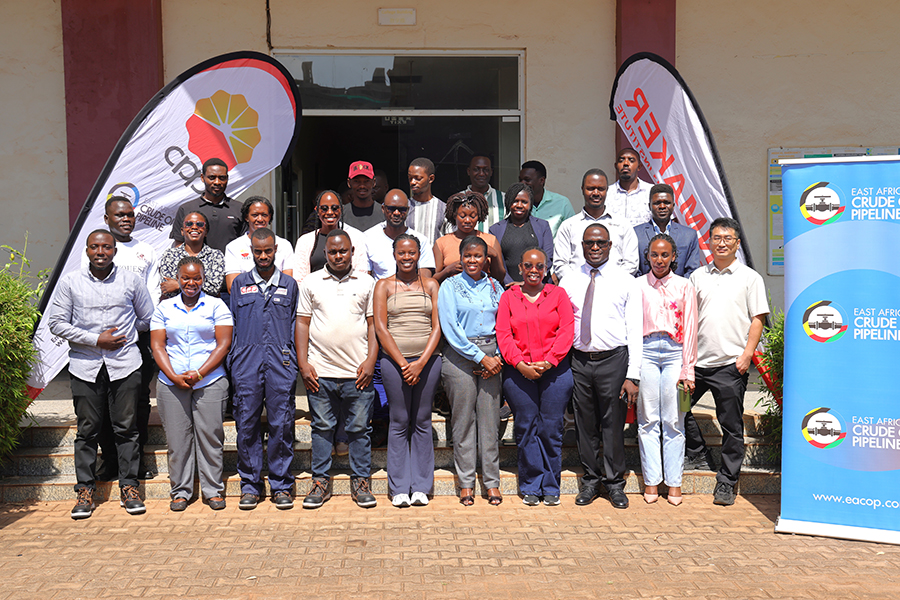
The graduates included employees of CPP and workers employed by its Tier 2 subcontractors, including Fulcrum and RIF Logistics.
The training was provided by Sunmaker Oil and Gas Training Institute, which is operated by Sunmaker Energy (Uganda) Limited. The institute provides professional training in areas including health, safety and environment, welding, mechanical and electrical skills, and oil and gas management.
Maria Nahabwe, National Content Manager at EACOP in Uganda, said the training forms part of the national content obligations imposed on contractors working on the pipeline project.
“CPP, as a company, has an obligation and national content commitments to train their staff,” Nahabwe said.
She said the requirement does not stop with the main contractor, but extends to companies working further down the contracting chain.
“They are training staff from both CPP and their contractors as well, who are now their Tier 2 contractors,” she said.
Nahabwe said CPP reviewed its workforce in areas where additional skills were needed and supported employees to obtain recognised professional qualifications.
She added that EACOP, as the project licensee, monitors the national content commitments of its Tier 1, Tier 2 and Tier 3 contractors.
“That is our role as the National Content Team. We work together with our contractors to make sure that they train their staff and make sure that they are developing their skill set,” she said.
According to Nahabwe, the more than 360 hours of training will be recorded as part of the national content activities reported to the Petroleum Authority of Uganda (PAU).
She said the qualifications could also make Ugandan workers more competitive within the wider East African labour market.
“We are receiving inquiries from as far as Kenya and Tanzania to see what skill set we have that they can easily utilise and take on as a region,” Nahabwe said.
Dalia Prince, Head of Projects and Business Development at Sunmaker Energy Uganda, said the courses were selected to address skills gaps in industries that require specialised safety and inspection personnel.
He said there is a shortage of qualified NDT inspectors, while many people working in health and safety positions do not hold internationally recognised professional certifications.
“The industry is short of qualified NDT inspectors,” Prince said.
“And the industry is awash with so many HSE personnel who are not certified. Maybe they learned on the job, but they do not have the certifications.”
Prince said Sunmaker first assesses the needs of a particular project before designing a training programme.
He said the institute prefers internationally recognised qualifications because they can make workers more competitive when seeking employment outside Uganda.
The training, however, does not guarantee employment with the company that sponsors it, Prince said.
He urged graduates to look beyond the oil and gas sector when searching for opportunities.
“It’s important that we manage expectations,” he said.
“If you’re NEBOSH-certified, you can work in manufacturing, you can work in construction. The opportunities are enormous. It’s just about mindset change.”
For Bukwanza Janet Gift, one of the workers who completed the NEBOSH course, the training changed her understanding of workplace safety.
“I thought health and safety is all about observing, seeing what’s wrong or what is right,” she said.
“But after sitting in a class of NEBOSH, I have come to know that safety is basically a culture. It all starts from top management up to the lowest level of a worker in the workplace.”
Bukwanza said workers often copy the behaviour of their leaders, making management’s commitment to safety an important part of creating safe workplaces.
She also said the course taught her that every worker has a personal responsibility for safety.
“It’s a personal responsibility to take care of yourself before you even look around or take care of other people,” she said.
Nansubuga Shirleen, a Skills Development Officer at the Petroleum Authority of Uganda, said internationally recognised certification would become increasingly important as Uganda moves towards oil production.
“Once you’re certified, it enables us to have professionals that can compete on the international level and can do work that is recognised at the level of other international refineries,” Nansubuga said.
She said Uganda would need qualified local workers to support the industry as it moves from construction into operations.
“We are moving to the operations phase, and for us to achieve our first oil, we shall need certified Ugandans supporting in some of these aspects,” she said.
Nansubuga also explained that professional certification such as NEBOSH should not be confused with a university degree.
A university degree provides academic and specialist education in a particular discipline, while NEBOSH provides professional training and certification in occupational health and safety.
She said the international recognition of the NEBOSH qualification can nevertheless give its holders an advantage when competing for jobs in different countries.
The training comes as Uganda prepares for the next phase of its oil and gas development, increasing the demand for workers with specialised technical and safety skills.