
The Stanbic National Schools Championship has entered its final stage, with eight schools selected to compete for the top prize at the grand finale in Kampala on August 28.
The eight finalists were selected from 12 regional finalist teams after a competitive appraisal process in which the students developed and refined their business ideas with seed funding.
The championship attracted 913 schools from across Uganda this year, bringing together students who were challenged to identify problems in their communities and develop practical solutions.
The programme, which has been running since 2016, aims to nurture entrepreneurship, innovation and problem-solving skills among young people.
Diana Ondoga, Stanbic Bank’s manager for corporate social investment, said the programme was intended to help prepare young people for their future roles as entrepreneurs, employees and leaders.
“We see this programme as our contribution to building Uganda’s next entrepreneurs, employees and leaders,” she said.
Ondoga said about 90% to 95% of the participating schools benefited directly from entrepreneurship and innovation training, even if their teams did not make it to the boot camp stage.
The championship also supports Uganda’s competency-based curriculum by encouraging students to develop skills in science, technology, engineering and mathematics, as well as critical thinking, creativity, teamwork and problem-solving.
The 12 regional finalists took part in a one-week boot camp at Gayaza High School in May, where they presented their ideas to judges and received guidance on how to develop them further.
The teams were then given seed capital to improve their projects. Their progress, viability, potential impact, and ability to address real problems were considered in selecting the eight teams that will compete in the final.
Among the finalists is Aga Khan High School, which has developed Renewablock Interlocking Blocks. The project uses plastic waste mixed with sand to make durable interlocking bricks.
The students say the innovation could provide a cheaper construction material while helping to reduce plastic pollution.
John Arinaitwe, a Senior Five student, said the project was designed with low-income communities in mind.
“This is to help every Ugandan regardless of their income status because we have people in informal settlements and people in rural areas who wish for better homes that are actually presentable,” he said.
St Kizito High School, Namugongo, is presenting Tunza Organics, an agribusiness project focused on sustainable food production, value addition and reducing food waste within the school community.
Senior Five student Barbra Ntunde said the project had taught students to be more open to new ideas.
“The projects teach us that we don’t have to always look up to the same things every time, but rather accept change, because it’s one of the ways we can change our lives, and also save our environment,” she said.
Florence Nambejja Kikomeko, an English teacher and project coordinator at the school, said she believed the skills acquired through the championship could help students create their own employment opportunities.
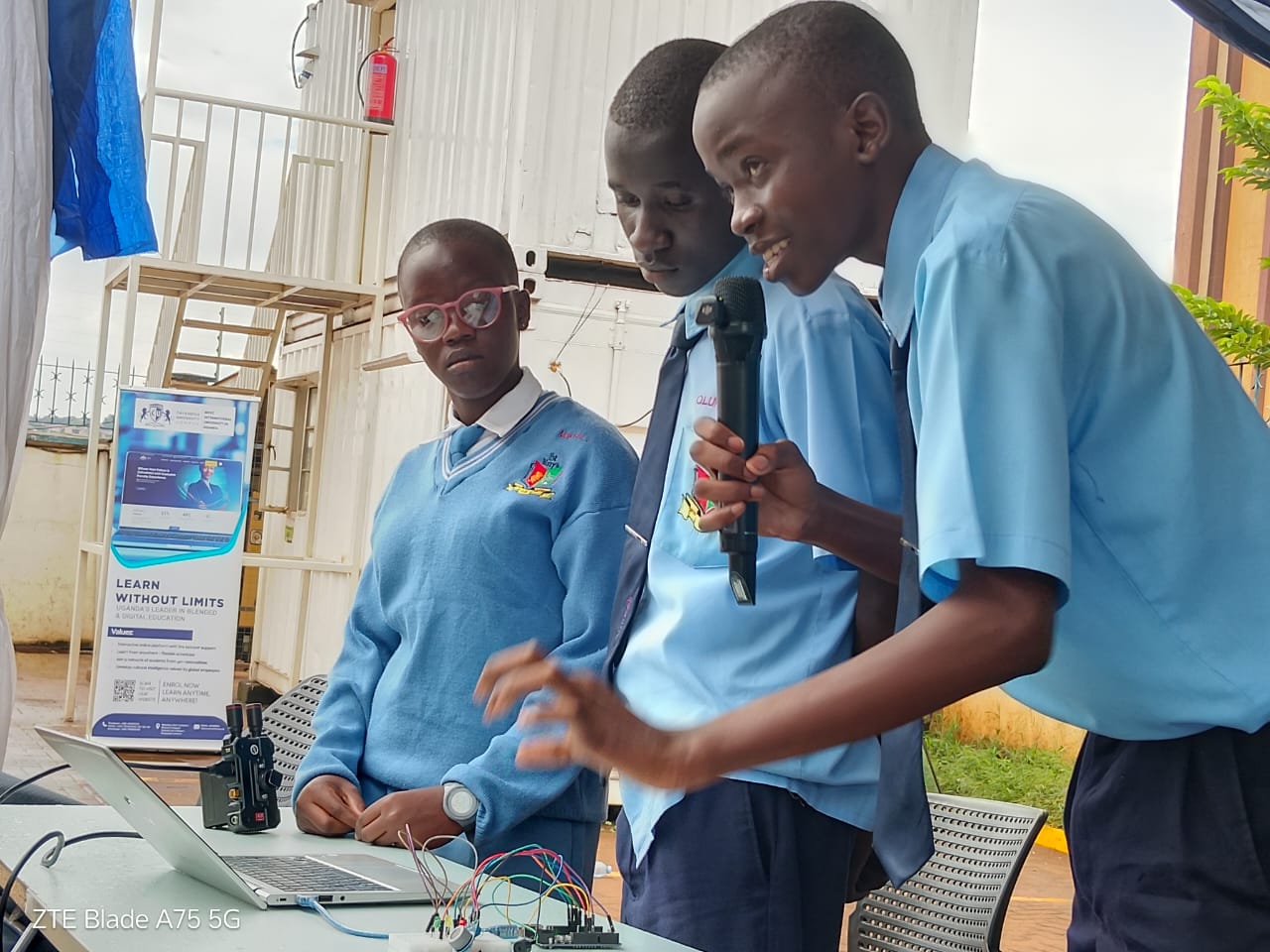
Kyebambe Girls Secondary School has developed a Smart Solar Irrigation System aimed at helping vegetable farmers irrigate their crops more efficiently.
The system uses solar power and is designed to regulate watering according to the needs of the crops, reducing water wastage and the amount of manual labour required.
Marian Owembabazi, a member of the team, said a working prototype had already been developed.
“At the moment, we have already developed a smart irrigation kit that is not manually operated. It is a system that works on its own and irrigates automatically. Although it is still in the development stage, it has made significant progress and is already functioning,” she said.
The team said the innovation could be particularly useful in Uganda, where agriculture remains an important part of the economy, and farmers often struggle with unreliable rainfall.
St Theresa Girls Secondary School, Nsenyi, is competing with the Terra Menstrual Pain Relief Belt, a wearable device designed to provide heat to help women manage menstrual pain.
Catherine Kabhogwe, a Senior Two student, said the team believed the product could eventually find a market beyond Uganda.
“I know many girls need this solution, and I believe this project can go beyond the borders of Uganda,” she said.
The students said their prototype is designed to generate heat of up to 40C.
Iganga Secondary School has developed the Iga Bank Cooler, a post-harvest storage and preservation innovation aimed at helping small-scale vegetable farmers and market vendors reduce food spoilage and financial losses.
Bartha Okurut, a member of the team, explained the problem the project is trying to address by pointing to the losses farmers can suffer when produce spoils before it reaches the market.
“You can’t harvest 50 kilograms of tomatoes and then make a loss of 45 kilograms. It means you are not going anywhere. Not because you don’t want to make profits, but because some challenges are beyond your control,” Okurut said.
The issue is particularly important in eastern Uganda, a major agricultural region where farmers grow crops including coffee, bananas, vegetables, rice, maize and groundnuts.
Kakira Secondary School has developed a Seed Planting Machine aimed at reducing the time and cost small-scale farmers spend planting crops.
The students said traditional planting methods can require several hours of labour for an acre, with farmers sometimes paying casual workers about Shs60,000 for the work.
Splendour Tusabe, a Senior Two student, said the team wanted to develop a machine that would be simple and affordable for farmers.
“Our research showed that planting remains one of the most labour-intensive activities for farmers. We wanted to develop a simple tool that any farmer can afford and use to save both time and money,” she said.
Bishop Dunstan Nsubuga Memorial Secondary School is presenting BFC Eco-Drop, short for Bottle For Cash, a recycling machine designed to encourage people to dispose of plastic bottles properly.
The machine allows users to deposit bottles into a collection unit. The team says the system can verify the bottles and credit a small reward to a linked digital account.
The project combines recycling with financial incentives in an attempt to encourage communities to take greater responsibility for plastic waste.
Sedes Sapientiae Academiae students have developed an agro-feed processing machine designed to help poultry farmers process feed ingredients at a lower cost.
Steven Turyamwesiimire, a member of the team, said many farmers had access to feed materials but lacked affordable equipment to process them.
“So, we decided to make a machine that can help farmers process their feeds at home without buying processed feed, and this helps them reduce feeding costs by 60% and increase their monthly profits,” he said.
The eight teams will now take their ideas before the judges at the August 28 grand finale, where they will compete for a multi-million-shilling cash prize.
But for Stanbic Bank, the competition is about more than determining a winner. It is also intended to give young people practical experience in identifying problems, developing solutions and turning ideas into possible businesses.
Ondoga said the championship was especially significant as Stanbic Bank marks 35 years of operations in Uganda.
She said the programme reflected the bank’s belief that the country’s economic growth depends partly on investing in the skills and ideas of its young people.
For the students, the final will provide an opportunity to test their innovations on a national stage. For Uganda, it offers a glimpse of how classroom ideas can be turned into practical solutions to everyday problems.