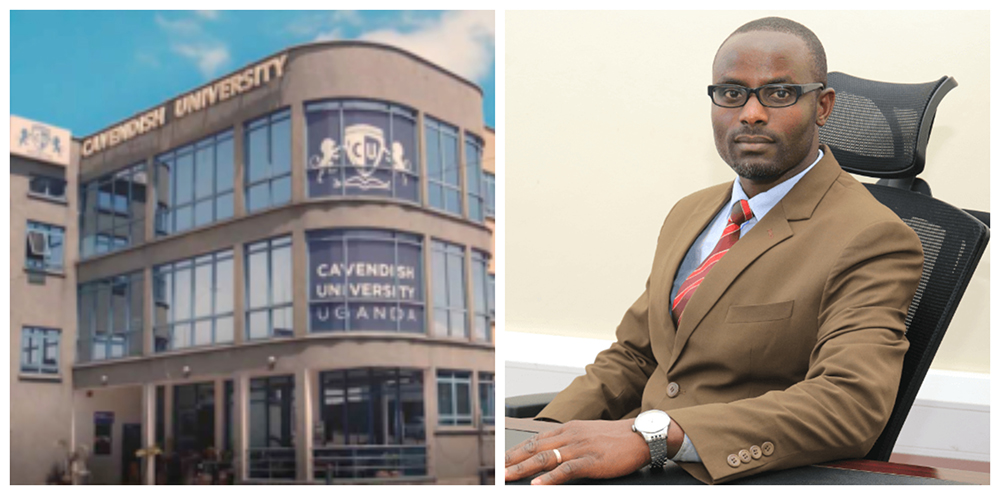
The Industrial Court has ruled that Cavendish University was right to dismiss a senior lecturer, Dr Fredrick Kiwuwa Lugya, after discovering that he held two full-time jobs, at Cavendish and Makerere University.
Cavendish University is a private university based in Nsambya, Kampala. It offers undergraduate and postgraduate programmes in law, business, health sciences, information technology and other fields.
In 2016, Dr Lugya signed a new two-year full-time employment contract with Cavendish University, and under clause 12 of the contract, he agreed to devote his time to the university and not take up any other full-time employment during the contract period.
Dr Lugya had worked for Cavendish since 2010 as a part-time lecturer, and in court he said the university had always known that he was also employed by Makerere University and had never objected to the arrangement.
According to him, university managers assured staff that the new clause banning other full-time employment would not be enforced.
In June 2017, he was appointed deputy project manager for the university’s Electronic Distance Learning project, and he says he was promised a separate contract and extra pay.
However, Dr Lugya said the promised remuneration never came despite repeated demands. When he informed management that he would stop working on the project at the end of September 2017 unless he was paid, events quickly took a different turn.
Instead of receiving payment, he was issued with a notice to show cause accusing him of breaching the university’s non-competition clause. He was suspended, summoned before a disciplinary committee and dismissed on November 3, 2017.
Dr Lugya took Cavendish to court challenging his dismissal on several grounds.
First, he argued that the disciplinary committee was illegally constituted because it did not include the deputy vice chancellor and the university’s legal officer as required by the Human Resource Manual.
Second, he maintained that the university dismissed him in retaliation after he demanded payment for work on the Electronic Distance Learning project.
Third, he said the clause stopping him from taking another full-time job was too broad and amounted to an unreasonable restraint on his right to work.
He insisted that he always met his teaching targets and key performance indicators and that his employment at Makerere University never affected his work at Cavendish.
Under cross-examination, Dr Lugya admitted that when he left Cavendish in November 2017, he was still a full-time employee of Makerere University. He also acknowledged running a pharmacy, agricultural enterprises and a consultancy business.
He accepted that clause 12 of the university’s Human Resource Manual prohibited another full-time job but argued that the disciplinary process itself was unfair because the committee lacked the required officials.
Cavendish University presented one witness, Dr Olive Sabiiti, the deputy vice chancellor for Academic Affairs, who told court that the university dismissed Dr Lugya because investigations established that he was simultaneously holding two full-time jobs.
She said his curriculum vitae submitted during recruitment indicated he had left Makerere University in 2012, yet he remained employed there throughout his time at Cavendish.
Dr Sabiiti testified that Dr Lugya was given a show-cause letter, suspended on half pay and invited to a disciplinary hearing where he admitted holding two full-time jobs.
During cross-examination, she explained that full-time staff were expected to be at the university during official working hours and that although staff could engage in other activities, they were prohibited from holding another full-time job.
She also acknowledged that there was no deputy vice chancellor or legal officer available when the disciplinary committee sat, saying the vacancies forced management to constitute the committee on a case-by-case basis as permitted by the Human Resource Manual.
Former Picfare worker, fired over missing pens, awarded Shs 9.9 million