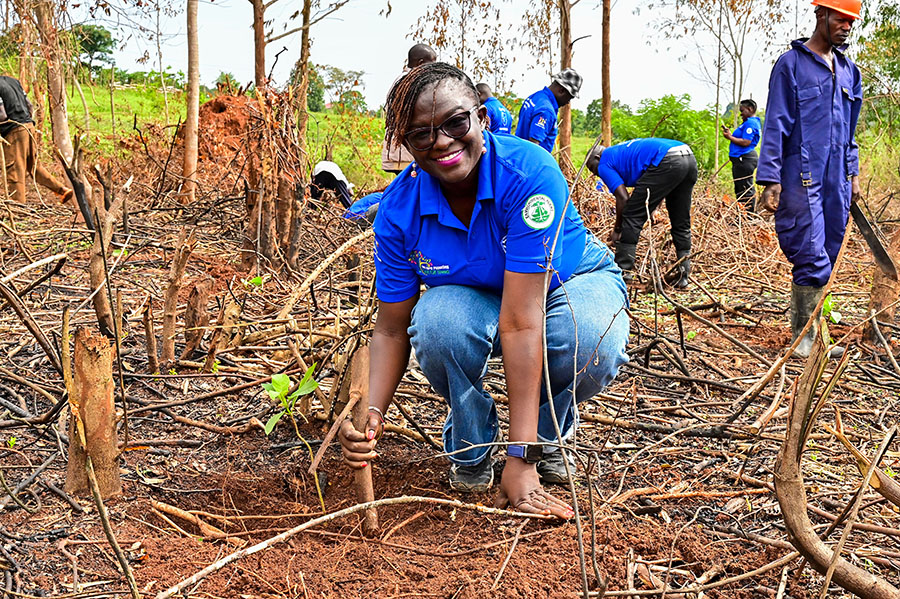
Stanbic Bank Uganda is supporting efforts to restore Manwa local forest reserve in Masaka City through the planting of more than 20,000 trees to rehabilitate the 144-hectare woodland, which serves as an important water catchment area.
The initiative is part of the bank’s contribution to the national Running Out of Trees (ROOTS) Campaign, a public-private partnership aimed at reversing forest loss and restoring Uganda’s degraded natural environment.
Stanbic Bank has contributed Shs150 million to the campaign and is targeting to plant 700,000 trees across the country.
The ROOTS Campaign is led by the Ministry of Water and Environment and brings together government agencies, civil society organisations, cultural institutions and private sector companies. It aims to mobilise the planting of 200 million trees over five years, ending in 2026.
Diana Ondoga, Stanbic Bank’s Corporate Social Investment Manager, said the bank was among the first private sector companies to join the campaign, recognising the importance of restoring forest cover in the fight against climate change.
She said Uganda needed to restore about 2.5 million hectares of forest cover to reduce the country’s exposure to the worst effects of climate change.
“Forest conservation requires sustained participation from residents, government agencies, environmental experts and other stakeholders,” Ondoga said.
She added that the bank would continue supporting environmental conservation through its Environmental, Social and Governance (ESG) strategy, both independently and in partnership with other organisations.
“Protecting forests is not the responsibility of one person or institution. It requires collective action from communities, environmental authorities and all other stakeholders,” she said.
Manwa Local Forest Reserve is an important natural resource for surrounding communities. Apart from supporting biodiversity, the woodland provides traditional medicinal plants and serves as a water catchment area for two lakes.
Saul Ndyabandiho, a forestry officer with the Ministry of Water and Environment, urged residents to stop illegal tree cutting, charcoal burning and encroachment on protected forest land.
He said community involvement was essential if Uganda’s forest restoration efforts were to produce lasting results.
“Communities must take the lead in protecting forests because they directly benefit from the resources they provide, including medicinal plants and water catchment services,” Ndyabandiho said.
His remarks come as the government prepares for the National Tree Planting Day on November 26, 2026, as part of efforts to encourage wider public participation in tree planting and environmental protection.
Ismael Mukiibi, the Stanbic Bank Masaka Branch Manager, reaffirmed the bank’s commitment to working with local communities and other stakeholders to sustain the restoration programme.
He encouraged residents to take responsibility for protecting the newly planted trees, saying their survival would be just as important as the initial planting exercise.
Valeriano Kiberu, the Manwa village chairperson, said communities living near the forest had benefited from its contribution to the local environment.
He observed that the area appeared to experience less severe drought conditions than some other parts of the country, which he partly attributed to the presence of the forest.
“When drought affects the country, we have not experienced the same situation here in Manwa, and our crops have continued to do well because of this forest. It also helps us access traditional medicinal plants,” Kiberu said.
John Kakande, the Masaka district chairperson, called on the government to take firm action against individuals involved in destroying forests, regardless of their political positions or influence.
He expressed concern that some people allegedly misuse their positions to engage in activities that undermine environmental conservation.
Kakande called for stronger enforcement of existing environmental laws to ensure that those responsible for forest destruction are held accountable.
Ndyabandiho warned that the success of the restoration programme would depend on what happens after the trees are planted.