The Uganda Development Bank (UDB) has commissioned a new 14-storey headquarters in Kampala, marking a major step in the bank’s efforts to strengthen its operations and expand its contribution to Uganda’s economic transformation.
The new UDB Tower is located at Plot 22, Hannington Road and brings the bank’s head-office operations together under one purpose-built facility.
The bank said the new headquarters will improve operational efficiency, staff collaboration, innovation and service delivery as UDB expands its role as Uganda’s national development finance institution.
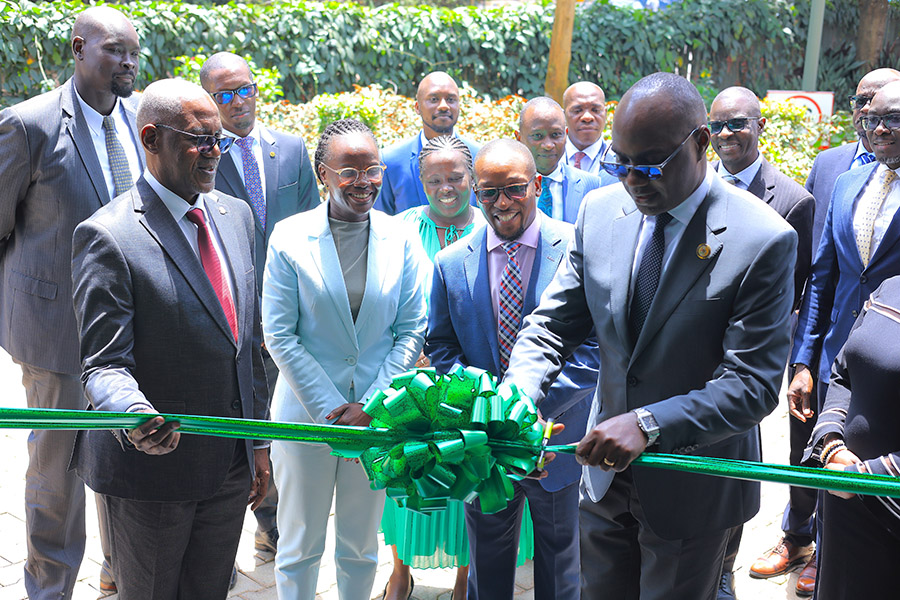
The commissioning was officiated by Finance Minister Henry Musasizi.
Musasizi said the new building reflected government’s commitment to strengthening institutions that can support Uganda’s long-term development plans.
He said Uganda’s next phase of economic transformation would require institutions capable of mobilising long-term capital and directing it towards productive sectors such as agro-industrialisation, tourism, mineral-based industrialisation, science, technology and innovation.
“UDB occupies a critical place in this national development architecture, connecting our development priorities with the capital and investment required to translate them into tangible economic opportunities for Ugandans,” Musasizi said.
He said stronger institutional capacity would allow UDB to play a greater role in financing investments that increase production, create jobs, grow exports and raise household incomes.
Musasizi said the new headquarters should therefore not be viewed simply as an investment in a building, but as part of efforts to strengthen the capacity of UDB to deliver its national mandate.
“Government expects UDB to continue leveraging its capital, expertise and partnerships to crowd in greater levels of private and development finance into the Ugandan economy,” he said.
UDB board chairman Geoffrey T. Kihuguru said the new headquarters should be understood as part of the bank’s long-term responsibility to help Uganda finance its own development.
He said UDB needed strong governance, skilled staff, adequate infrastructure and the ability to mobilise capital if it was to support productive enterprises and investments of national importance.
“UDB Tower represents more than the growth of an institution. It represents our continued investment in Uganda’s capacity to finance its own development aspirations,” Kihuguru said.
He said the new facility would provide infrastructure that matches UDB’s growing responsibilities and would support the bank’s efforts to remain resilient and sustainable.
“Our responsibility is to build a development finance institution that is not only relevant to Uganda’s needs today, but one that has the capacity and resilience to serve generations to come,” he said.
UDB managing director Dr Patricia Ojangole said the commissioning marked an important stage in the bank’s institutional transformation.
She said bringing staff and operations together under one roof would improve collaboration and create a better working environment for delivering services to customers and partners.
“Beyond providing a modern and efficient working environment, it brings our people and operations together in a space designed to strengthen collaboration, innovation and service delivery,” Ojangole said.
She said the investment in a permanent headquarters also reflected the bank’s long-term approach to institutional sustainability and operational efficiency.
“As Uganda’s national Development Finance Institution, our mandate requires us to think and invest for the long term,” she said.
The new tower occupies about 7,806 square metres and has 14 floors, including two basement levels.
It houses modern offices, customer-service facilities, meeting and training rooms, an innovation room, a boardroom and modern information and communication technology infrastructure.
The building will also include an auditorium and resource centre intended to support UDB’s role as a source of knowledge and expertise in development finance.
UDB said the new facility was designed with energy efficiency and environmental sustainability in mind.
The building has a 25-kilowatt solar power system to supplement electricity from the national grid. It also has modern lighting controls and zoned air-conditioning systems designed to reduce unnecessary energy consumption.
UDB said these features would help improve the management of energy, security, safety and other critical building systems.
The commissioning comes as UDB continues to expand its development finance activities across Uganda.
The bank has been seeking to strengthen its capacity to provide long-term financing to businesses and projects in sectors considered important to economic growth, including agriculture, manufacturing, tourism and infrastructure.
UDB reported a profit after tax of Shs63.4 billion in 2025, total assets of Shs2.26 trillion and gross loans of Shs1.77 trillion.
The bank said it approved Shs518.4 billion in loans and disbursed Shs502.2 billion to 112,392 borrowers during the year.