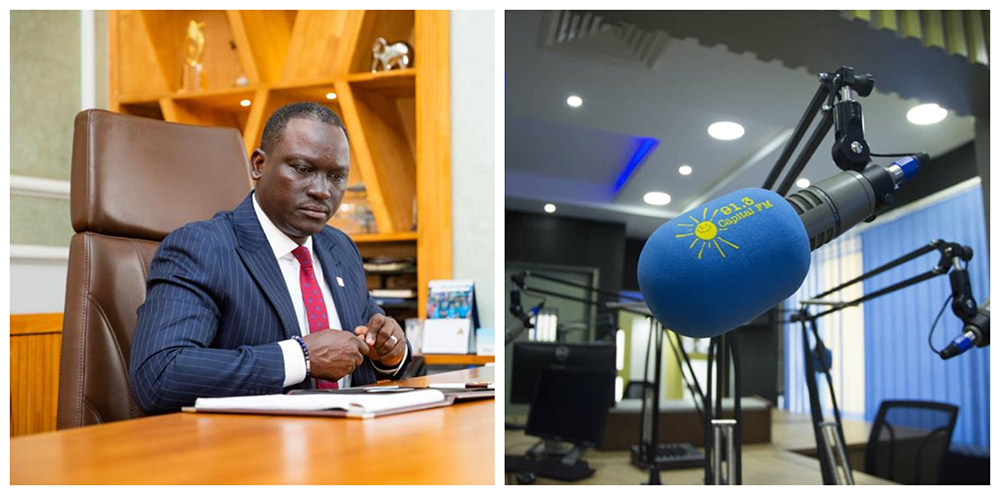
Staff at Capital FM are bracing for a shift in workplace culture as the radio station prepares to relocate from its long-time home in Kisementi, Kololo, to Next Media Park in Naguru this October.
The move follows the takeover of Capital Radio 20Limited, the parent company of Capital FM, Beat FM and KIIS FM, by Next Media Group boss Kin Kariisa. Kariisa completed a full buyout of the group last month, ending decades of ownership by Patrick Quarcoo and William Pike.
Two long-serving Capital FM employees, who spoke to Bbeg Media on condition of anonymity, said they were worried the free-spirited culture they have known for years would not survive under Next Media’s structure.
“At Capital we are free to say anything. We engage in banter and all. We criticise whoever openly,” said one female employee. “I am not sure that will continue when we move to Next Media.”
Another employee said the bigger fear was self-censorship. Staff worry they could be judged as anti-government or anti-NRM once they are working inside Next Media, a company Kariisa has built into one of Uganda’s most influential media houses.
It is no secret that Kariisa is a card-carrying member of the ruling National Resistance Movement (NRM). But in meetings with staff, he has always maintained that his political beliefs stay outside the gate at Naguru and do not shape editorial decisions at Next Media.
Even so, he is widely viewed within media circles as closely aligned with the establishment.
Under the terms of the acquisition, Kariisa, through Next Media Services and in his personal capacity, acquired all 2,024 issued shares in Capital Radio 2015 Limited.
Next Media Services took up 1,417 shares, about 70% of the company, while Kariisa personally holds the remaining 30%. Because Kariisa also owns 99.9% of Next Media, the transaction effectively places the entire Capital Radio business under his personal control.
While the value of the deal has not yet been disclosed, sources said the transaction cost Kariisa not less than Shs12 billion, a figure that covers Capital FM’s vast transmitter infrastructure, its regional frequency licences and its brand value, built over 33 years.
In an interview with CEO East Africa Magazine about why he pursued the acquisition, Kariisa argued that no single radio or television station can now survive as a standalone commercial entity in Uganda’s crowded market.
He said that, in the next three years, given the prevailing economic situation and the rise of social media platforms, no radio or television station will survive on its own as a single commercial entity in this market.
Kariisa explained that Capital FM, Beat FM and KIIS FM each serve different audiences, from English-speaking urban professionals to Luganda-speaking mass audiences and younger listeners, and that bringing them under one roof strengthens his overall ecosystem rather than diluting any single brand.
Independence
Capital FM has occupied a distinct place in Uganda’s media landscape since it went on air on December 31, 1993, becoming the second FM station in the country after the liberalisation of the airwaves.
It was founded by Pike, a former New Vision managing director, and Quarcoo, at a time when most lenders doubted FM radio would work in Uganda.
The station built its reputation on shows such as Capital Gang, a Saturday morning talk programme that became a fixture of political and social debate, and Desert Island Discs, which once landed an early interview with the Kabaka Ronald Muwenda Mutebi.
Over the years, Capital FM has been home to some of Uganda’s best-known broadcasters and commentators, among them Timothy Kalyegira, veteran journalist Charles Onyango-Obbo, Robert Ssemujju Ibrahim Nganda, Frank Katusiime and Andrew Mwenda, all of whom featured prominently on its talk shows.
Quarcoo and Pike were known within the industry as owners who rarely interfered in the editorial or day-to-day work of their journalists. Both men have since relocated to Nairobi, where they run several other business interests.
Yet the transition from Kisementi to Naguru may not be as jarring for everyone at Capital FM. A number of Capital FM staff have previously worked at Next Media in various roles, with mixed results, including Shawn Kimuli, Aisha Nassanga and Karitas Karisimbi.
Kariisa himself has framed the Capital Radio acquisition as part of a much bigger plan. He is building an integrated radio, television and digital ecosystem around brands including Capital FM, Beat FM, KIIS FM, NBS TV, Nile Post, AfroMobile and MTNTV, with ambitions to reach 30 million Ugandans daily by June 2027.
For now, though, the mood among some Capital FM staff is one of caution. Whether the station’s free-spirit culture can survive intact inside Next Media’s Naguru headquarters remains an open question, one that will likely become clearer once the move is complete in October.