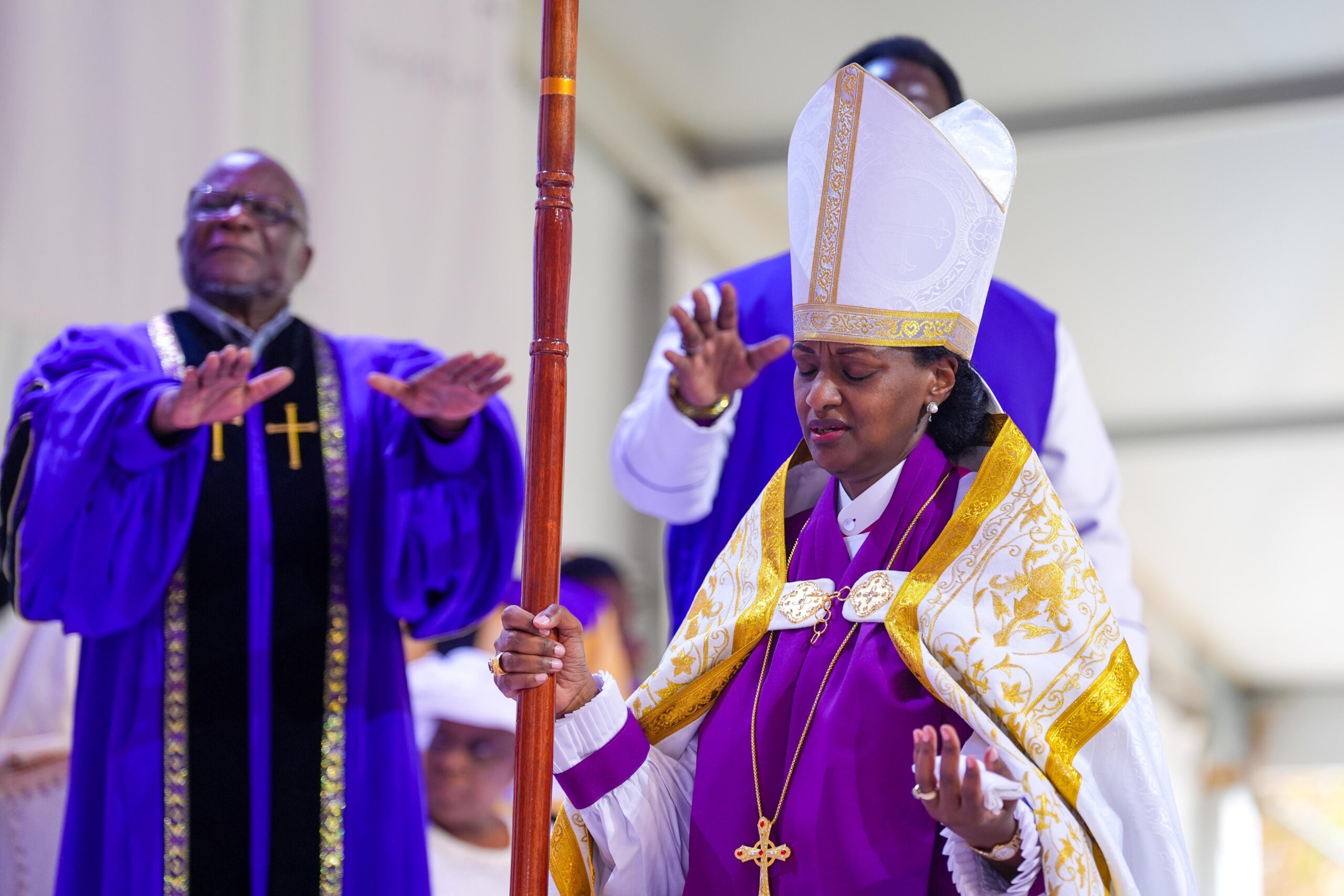
Pastor Patience Kokundeka Rwabwogo has been consecrated as an Episcopal Bishop of Covenant Nations Church, 20 years after she started the ministry as a small house fellowship.
The consecration took place at Covenant Hill in Maya as Covenant Nations Church celebrated two decades of ministry. Bishop Dr LaDonna Osborn was the chief consecrator, with Archbishop Moses Odongo and Bishop Joshua Lwere serving as co-consecrators.
The ceremony brought together church leaders, government officials, relatives, believers and friends. Pastor Enoch Adejare Adeboye and his wife, Pastor Folu Adeboye, were among the high-profile guests.
The occasion was presented as a major milestone in Uganda’s Christian history, with church leaders describing Bishop Patience as the first woman to be ordained as a bishop in Uganda.
In Uganda, where political families are sometimes associated with powerful titles and large public ceremonies, this particular promotion came with an unusual qualification: it was made in a church, not at a party caucus.
Allen Kagina, speaking on behalf of the elders of Covenant Nations Church, said Patience’s elevation followed two decades of ministry, leadership and service.
She said the elders had considered her character, conduct, doctrine, leadership and ministry before presenting her for consecration.
“Twenty years ago, God planted within her heart a vision that began humbly as a small house fellowship,” Kagina said.
She said the fellowship had grown into Covenant Nations Church through prayer, obedience and perseverance.
According to Kagina, Patience’s ministry has gone beyond preaching to include leadership development, professional excellence, entrepreneurship and economic empowerment.
She said Patience had also concentrated on young people, students and young professionals, encouraging them to discover their purpose, build their lives on the Bible and use their education and talents to serve society.
Her work, she said, has included Bible teaching, mentorship, conferences, leadership seminars and evangelistic missions.
Kagina also praised Patience for working with her husband, Odrek Rwabwogo, to bring together Christian leaders from different denominations for prayer, revival and evangelism.
One example she gave was the Light Up Uganda for Jesus Gospel Convention, which brings together Christians from different denominations.
She said Patience’s ministry had a pastoral, teaching and prophetic role and was aimed at strengthening the Church, raising leaders and spreading the Gospel.
The elders stressed that the consecration should not be viewed as a personal promotion but as a call to greater responsibility.
President Museveni, who is Patience’s father, congratulated her and described the occasion as significant for both the family and Uganda’s Christian history.
Before turning to his daughter’s new office, Museveni thanked God for the recovery of First Lady Janet Museveni and praised the medical staff who treated her.
He also thanked their children, Muhoozi, Natasha, Patience and Diana, for supporting their mother during her illness.
Museveni then gave the congregation something of a family history lesson.
He said his ancestors had lived in the area for millions of years and recalled the arrival of different Christian and Muslim traditions in Uganda.
He said Muslims arrived in 1841, Anglicans in 1877, and Catholics in 1879. He added that several generations of his family lived through these changes without joining a church.
“My great-fathers were alive; they never joined the Church. My grandparents were also alive; they never joined the Church. It was Mzee Kaguta who joined the Church for the first time in 1947,” Museveni said.
Then came the punchline.
“But in all these years, I had never even heard of a catechist. Today, I have a whole Bishop,” he said.
Museveni also said that he had spent 12 years studying the Bible, starting with Genesis and moving through the books of the Old Testament.
He nevertheless said his daughter’s writings had introduced him to biblical perspectives he had not previously considered, including information about the descendants of Lot and Esau.
“I surrendered because she had read the Bible,” Museveni said.
The president urged religious leaders to make Christianity relevant to people’s everyday lives.
He said religious leaders should address problems such as sickness, hunger and bondage instead of merely managing religious institutions.
“You have heard what Bishop LaDonna said. They are all saying that if a Bishop doesn’t have the spirit of a Bishop, he is just an executive, managing, but not a spiritual leader,” Museveni said.
He added that religious leaders should follow the example of Jesus Christ by helping the sick, feeding the hungry and freeing people from bondage.
“But if you religious leaders don’t address that, you are wasting time,” he said.
And then came the livestock contribution.
Museveni told the congregation that he and the First Lady had given their daughter 50 cows as part of their traditional practice.
“In our traditional way, I gave Patience 50 cows, and the cows are from Maama and myself,” he said.
So while some families might mark a daughter’s new job with flowers, dinner or perhaps a congratulatory message, the Museveni family apparently went with cattle.
First Lady Janet Museveni described the ceremony as a special day for the family and the Christian community.
In her thanksgiving message, she reflected on Uganda’s difficult past, including conflict, displacement and poverty. She also thanked God for what she described as the country’s progress over the past four decades.
She said Uganda had moved from a country affected by war to one that participates in regional peacekeeping and hosts refugees from neighbouring countries.
Janet Museveni also gave thanks for her recovery, describing 2026 as a year in which she believed God had preserved her life. She thanked Christians who had prayed for her during her illness.
Turning to her daughter, she said the family was overwhelmed with joy at Patience’s consecration.
“Today, we celebrate the consecration of our daughter, Patience, to the office of a Bishop,” she said.
She said Patience had answered the call to ministry about 20 years ago and prayed for God to give her and Rwabwogo strength and grace in their new responsibilities.
Bishop Osborn, the chief consecrator, used the occasion to call for a Church that does more than preserve institutions.
She said Christians did not have to agree on every form or interpretation of faith but should remain united through their common belief in God.
“A Bishop is supposed to lift people and give them a new beginning,” Osborn said.
She challenged the Church to become an instrument for social transformation.
“The Church doesn’t need leaders who preserve the institutions, but one that heals nations,” she said.
Odrek Rwabwogo, Patience’s husband, placed her consecration within Uganda’s longer Christian history.
He spoke about the Christian revival in Ankole and recalled early converts, including Mariam Kakyibara, whom he described as the first woman to be baptised in 1902.
He said the sacrifices of early Christians helped prepare the ground for the East African Christian revival.
“Today, the Lord has chosen our own Patience to be the first woman to be ordained Bishop in Uganda,” Rwabwogo said.
Rwabwogo said Patience’s ministry had been built over years of service and that her new position would require her to guide and challenge the next generation.
He also warned against a generation that gives greater importance to intellectualism, political power and material wealth than to faith and godliness.
The ceremony itself was filled with the symbols of episcopal office.
Patience received the chemere from Apostle Alex Mitala, the scarf or tippet from Bishop Simon Peter Emiau, the cross from Archbishop Moses Odongo and the ring from Pastor Adeboye.
Bishop Joshua Lwere presented the cope, while Bishop Osborn presented the mitre. Adeboye presented the staff. The ceremony also included the laying on of hands, anointing with oil, and prayers.