The former Minister of Internal Affairs, Kahinda Otafiire, has told Parliament that Uganda’s digital number plate system was found to function more like a fleet management system than a security system, raising questions about its ability to support police investigations.
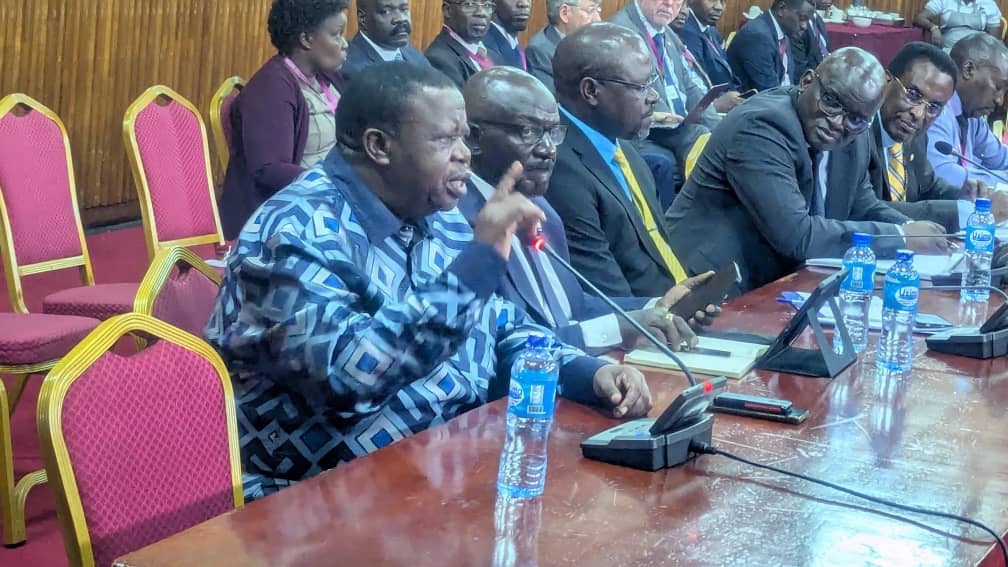
Otafiire, who is now the Minister of Water and Environment, made the remarks while appearing before Parliament’s Committee on Physical Infrastructure alongside former Works and Transport Minister Gen. Edward Katumba Wamala to explain their roles in the government’s agreement with Joint Stock Company, the Russian firm contracted to implement the digital number plate project.
The two former line ministers appeared before the committee because they were in government when the agreement was being developed and implemented.
Otafiire told the committee that he had raised concerns about the technical feasibility of the project following investigations and consultations with technical institutions, including Makerere University.
He said the digital number plate system faced a fundamental compatibility problem because the police closed-circuit television (CCTV) cameras were manufactured using Chinese technology, while the tracking chips were Russian.
According to Otafiire, the two technologies could not work together as required, undermining the system’s intended security functions.
“I resisted after thorough consultations because the CCTV cameras were Chinese and the chips were Russian, and the two were not compatible. But I was overpowered,” Otafiire told the committee.
He said his concerns were not adequately addressed before the project proceeded.
Otafiire further told legislators that after the devices were installed, police discovered that the system could identify a vehicle’s location but could not effectively track its movement as expected.
“After installation, police discovered that the digital formula employed was a fleet management system rather than a security one,” he said.
A fleet management system is generally used to monitor vehicles, including their locations and operational movements, while a security-focused tracking system is expected to provide capabilities that help law enforcement monitor vehicles and support investigations.
Gen. Katumba Wamala, who served as Minister of Works and Transport when the project was being implemented, told the committee that his ministry became involved at a later stage, with the Ministry of Security taking the lead in the project.
“We did not secure global security for number plates, but it was for security, security and security. We came at the last entry,” Katumba said.
He also questioned the state of the manufacturing facility that was expected to be established at Kyambogo to support local production of the digital number plates.
Katumba told the committee that although machinery had been installed at the site, there was little evidence of actual manufacturing taking place.
“There is no manufacturing in Kyambogo. There are machines but no manufacturing,” he said.
The digital number plate scheme has attracted scrutiny over its cost, implementation and expected security benefits.
Parliament’s ongoing engagements are intended to establish how the project was designed, who was responsible for key decisions, and whether the technology delivered what the government had promised.