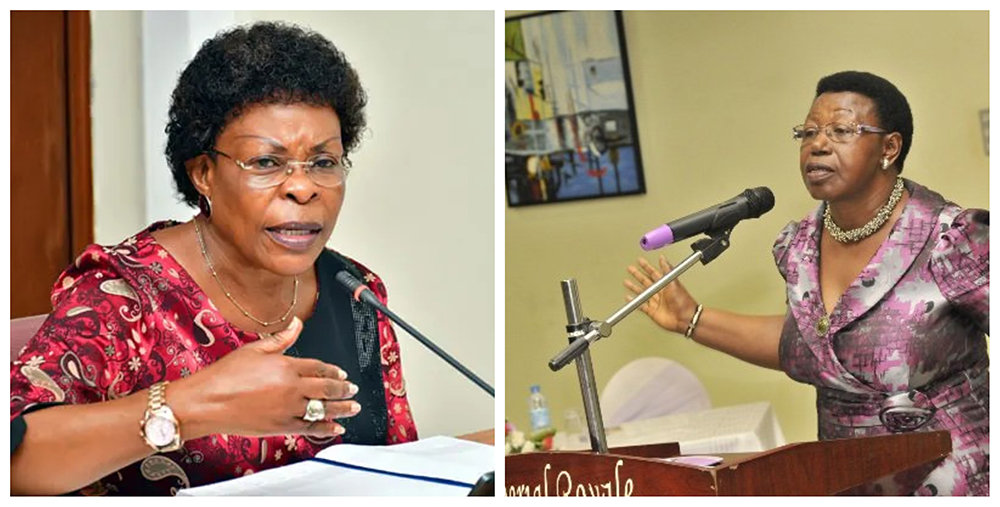
The High Court has dismissed a defamation case in which Beti Kamya, the former IGG, sued veteran politician Miria Matembe for calling her a “political prostitute” during various interviews on NTV and NBS TV.
Justice Isaac Teko said Matembe’s comments were “protected political opinion and not defamatory” in any way.
READ FULL RULING HERE..https://ulii.org/en/akn/ug/judgment/ughccd/2026/179/eng@2026-05-11
The dispute between Kamya and Matembe, two prominent female politicians, goes back to two television interviews. On July 16, 2021, Matembe appeared on NTV Uganda, and on December 9 2021. In those interviews, the vocal politician made comments about Kamya that she found deeply offensive.
Matembe said Kamya was “a person of questionable character, I mean lack of integrity.” She also accused Kamya of interfering with the Uganda Land Commission (ULC) during her time as minister of Lands by creating compensation lists that included people who did not exist and facilitating double payments to fake beneficiaries.
On top of that, Matembe called Kamya a “political prostitute.”
Kamya took Matembe to court, asking it to declare the statements false and defamatory. She also wanted a permanent injunction stopping Matembe from repeating them, an apology and retraction, and an award of general, punitive and exemplary damages.
Now here is the irony that many Ugandans following this case will find hard to miss. Both women have, at different points in their lives, been fierce critics of President Museveni’s government, and both have also served in his cabinet.
Kamya started in opposition politics. She was involved with the Reform Agenda pressure group, became an MP for Lubaga North in 2006, founded the Uganda Federal Alliance in 2009 and even ran for president against Museveni in 2011.
In 2016, she crossed over to government, becoming minister for Kampala and later for Lands, Housing and Urban Development. After the 2021 elections, Kamya was appointed Inspector General of Government (IGG) by Museveni.
Matembe’s story runs in a similar shape but in reverse order. She was minister of State for Ethics and Integrity from 1998 to 2003, a job in which she earned a reputation as a tough anti-corruption crusader. She was sacked from that position in 2003 after opposing Museveni’s attempts to remove presidential term limits from the Constitution.
Since then, she has become one of the most outspoken critics of the Museveni government, often appearing on television and radio talk shows to give blunt opinions on governance.
So, in essence, Kamya, a former critic turned government insider, was hauling Matembe, a former government insider turned critic, to court for questioning her integrity. It is the kind of political theatre Uganda has become used to.
In court, the two sides had very different arguments. Kamya was represented by lawyers from Anguria & Co. Advocates, while Matembe relied on legal counsel from Mike Baingana & Co. Advocates.
Kamya’s lawyers argued that Matembe’s words were defamatory because they portrayed their client as corrupt, dishonest and unfit for the office of Inspector General.
They pointed out that Kamya had never been convicted of any crime or found guilty of misconduct by any court. They also argued that Matembe could not rely on a parliamentary report from the COSASE committee to justify her statements, because that report was only published after the broadcasts were made.
During cross-examination, Matembe herself conceded that the COSASE report could not have formed the basis of her opinion because it came afterward. Kamya’s team also argued that the word “prostitute” carries deeply negative connotations regardless of what comes before it.
Matembe’s lawyers countered that her comments were fair political comment on a matter of huge public interest, namely the suitability of a senior public official.
They argued the statements were substantially true, protected under Article 29 of the Constitution, which guarantees freedom of expression, and that as a senior public figure, Kamya had to tolerate robust criticism.
On the “ghost beneficiaries” claims, Matembe leaned on the COSASE report, which had flagged a claimant called “Nantalia Namuli” whose supporting documents were allegedly forged.
As for “political prostitute,” Matembe’s lawyers said the phrase was political rather than sexual, referring instead to politicians who repeatedly switch parties for personal gain, a description they said fit Kamya because she had moved from FDC to Uganda Federal Alliance and finally to the NRM.
In the end, Justice Teko sided almost entirely with Matembe, arguing that the COSASE report, even though it was produced after Matembe’s remarks, still pointed to a real and ongoing public controversy about compensation irregularities at the ministry of Lands during Kamya’s time there.
On the “political prostitute” remark, he said “the phrase, though insulting, amounted to political rhetoric rather than actionable defamation.”
He also faulted Kamya for not bringing any independent witnesses to show that ordinary Ugandans actually thought less of her because of Matembe’s views.
Justice Teko noted that reputation is about “what other people think about a man and not what a man thinks about himself.”
He was clear that defamation law is not meant to shield politicians from harsh criticism.
“Freedom of expression, important as it is, is not a licence to publish false imputations of corruption, fraud, criminal conduct or moral depravity without legal consequence,” he said, adding that in this case Matembe’s remarks fell on the protected side of that line because they were political opinion grounded in public controversy.
In the end, Justice Teko dismissed Kamya’s case in its entirety, meaning Matembe can still call her a “political prostitute” over and over again, without fear of legal repercussions.