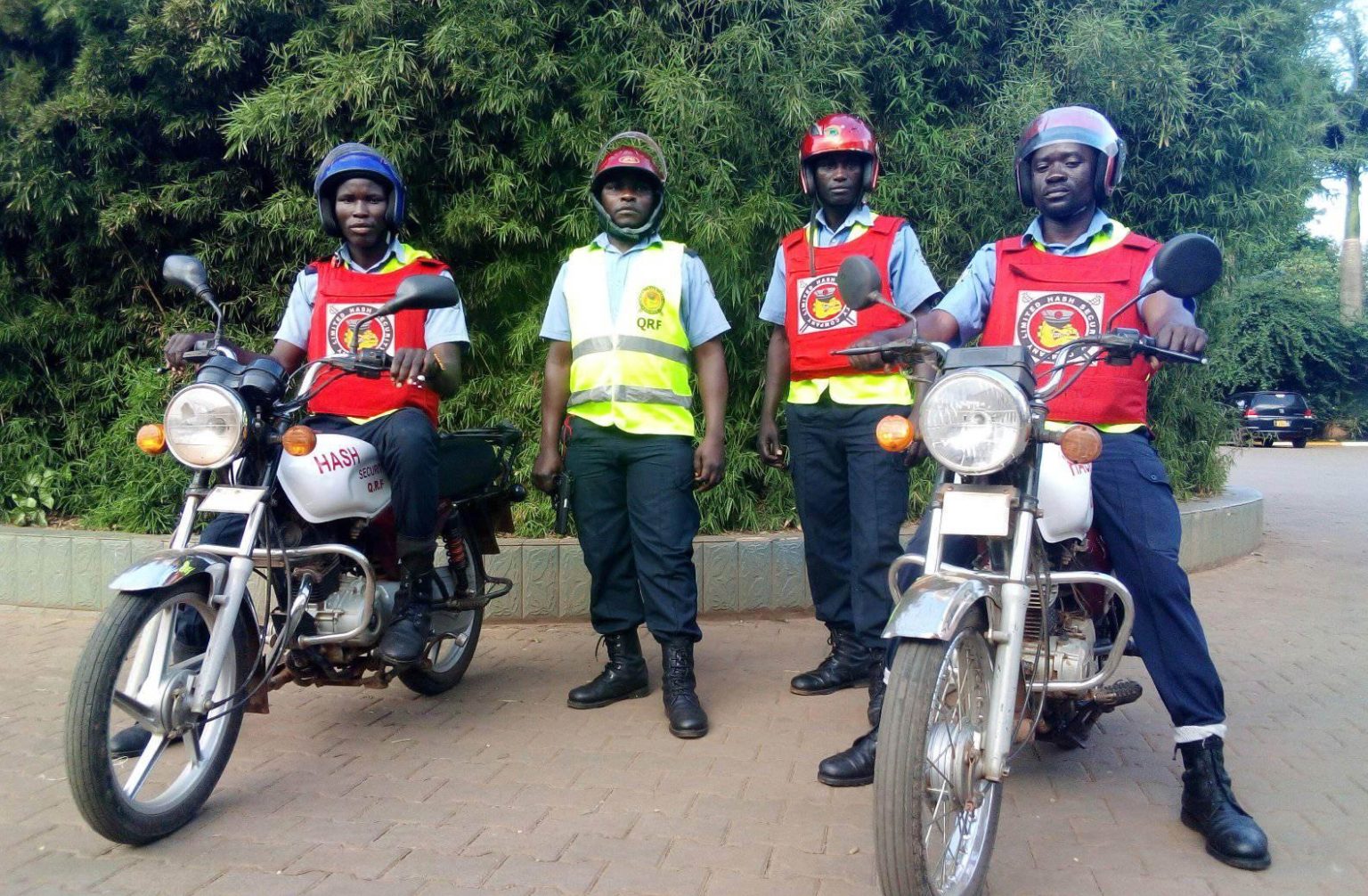
Private security firm Hash Security has been ordered to pay Shs115 million to a man who was shot twice in the thighs by one of its guards during a confrontation outside a bar in Bulenga in April 2022.
Justice Bonny Isaac Teko said the firm was responsible for the injuries suffered by Zein Bukenya after one of its guards, Enock Muyinza Busuulwa, discharged a loaded firearm during the incident at Devanna Bar and Lounge in Bulenga.
Bukenya sued Hash Security seeking compensation for the injuries, medical expenses, lost property and other costs arising from the shooting.
The court heard that Bukenya had accumulated a bar bill of Shs116,000 during the evening. He was later asked to settle the bill, after which an argument developed between him and Muyinza, who was working as a security guard at the bar.
According to Bukenya, his phone battery had died, and he said he would return and pay the bill via Mobile Money after charging it. He said he was allowed to leave the bar with three companions.
His companions left, but Bukenya remained on the main road waiting for a boda boda. It was there, he said, that Muyinza confronted him and demanded that he return to pay the bill. During the confrontation, the guard’s firearm went off twice, hitting Bukenya in the back of both thighs.
Bukenya was taken for emergency treatment before undergoing major surgery at Mulago Hospital under orthopaedic surgeon Dr Yasin Sekamatte. Muyinza was later arrested, but the criminal charge brought against him was dismissed.
But Hash Security countered that Bukenya had refused to pay the bill, became aggressive, and pushed security guards before attempting to leave on a boda boda.
According to the company’s version, Muyinza stopped the boda boda rider and explained that Bukenya had not paid his bill.
Hash Security further claimed that Bukenya had earlier presented himself as a United States Marine who could disarm the guard. It said he then attempted to grab Muyinza’s loaded firearm.
The company argued that during the struggle Bukenya himself pulled the trigger, causing the gun to fire twice and injure him in both thighs.
The dispute therefore came down to a crucial question: was Bukenya shot because Hash Security’s employee negligently handled a loaded gun, or did Bukenya cause his own injuries while allegedly struggling for control of the firearm?
Bukenya was represented by Kalibbala Ruta & Co Advocates, while K&K Advocates represented Hash Security.
Bukenya’s lawyers argued that Hash Security owed him a duty of care because the person who shot him was its employee and was carrying the company’s firearm while performing his security duties.
They argued that the duty was particularly high because Muyinza was carrying a loaded and cocked AK-47 in a place where members of the public were present.
The lawyers told the court that engaging a civilian in a physical confrontation while carrying such a weapon amounted to a failure to exercise the care expected of someone handling a dangerous firearm.
They also challenged the company’s explanation that Bukenya had wrestled the gun from the guard and accidentally shot himself.
According to Bukenya’s lawyers, that explanation was difficult to believe and did not fit the medical evidence showing that the bullets entered the back of both thighs and exited through the front.
They asked the court to accept Bukenya’s account and find Hash Security liable for negligence.
On the unpaid bill, they argued that even if Bukenya had failed to settle the Shs116,000, the debt did not give the security guard the right to use potentially lethal force.
“A commercial debt could only be enforced through lawful means,” the lawyers submitted.
Hash Security’s lawyers, however, argued that Bukenya had failed to prove negligence, maintaining that the guard was lawfully carrying the firearm as part of his work.
The company also argued that Bukenya knew the guard was armed but confronted him. It said he had voluntarily exposed himself to the danger and should therefore be denied compensation under the legal principle known as volenti non fit injuria.
The company further invoked the defence of illegality, arguing that Bukenya’s claim was connected to his alleged refusal to pay his bar bill, his attempt to leave without settling the bill, threats against the guard and alleged attempt to take the firearm.
It also argued that Bukenya had contributed to his injuries through his own conduct and asked the court to either dismiss the case or reduce any damages awarded.
Court clears URA officer in Shs15m bribery case but upholds colleague’s conviction
After hearing arguments from both sides, Justice Teko rejected Hash Security’s account of the shooting, saying that Muyinza owed Bukenya a duty of care because he was an armed security guard entrusted with a loaded firearm and deployed in a commercial environment used by members of the public.
“The danger presented by a firearm is obvious and foreseeable. The standard of care required of a person handling such an instrument must correspond to that danger,” Justice Teko ruled.
He pointed to the medical evidence from Dr Sekamatte, who treated Bukenya, which showed that the bullets entered the back of both thighs and exited through the front.
Justice Teko said this was difficult to reconcile with Hash Security’s version that Bukenya had taken control of the rifle during a face-to-face struggle and accidentally shot himself.
He consequently found that Bukenya had not struggled with Muyinza or attempted to seize the firearm but instead, he said, the negligence occurred when the guard engaged Bukenya in a physical confrontation while carrying a loaded firearm.
Justice Teko said that even if Bukenya knew the guard was armed, that knowledge did not amount to consent to the negligent discharge of the firearm.
“Knowledge of danger is not, without more, voluntary assumption of the particular risk complained of,” he said.
He also rejected the illegality defence, finding that Bukenya’s lawsuit was not based on the unpaid bar bill.
“[Bukenya’s] cause of action is not founded upon the alleged non-payment of the bar bill. He seeks compensation for personal injuries caused by the negligent discharge of a firearm by [Hash Security’s] employee,” Justice Teko said.
In the end, he said Hash Security had not proved that Bukenya committed the alleged offences.
“I have found no proved act or omission on [Bukenya’s] part which materially contributed to the gunshot injuries,” he said.
On the issue of compensation, Justice Teko awarded Bukenya Shs100 million in general damages even though he had sought Shs 250 million.
He said the evidence did not show permanent disability, permanent shortening of the legs, permanent deformity or sexual or reproductive impairment.
He also awarded him Shs15 million in special damages, meaning that in total, Hash Security was ordered to pay Bukenya Shs115 million before interest, which was set at 10% per annum from the date the case was filed in 2022.
Hash Security was also ordered to pay Bukenya’s legal costs.