
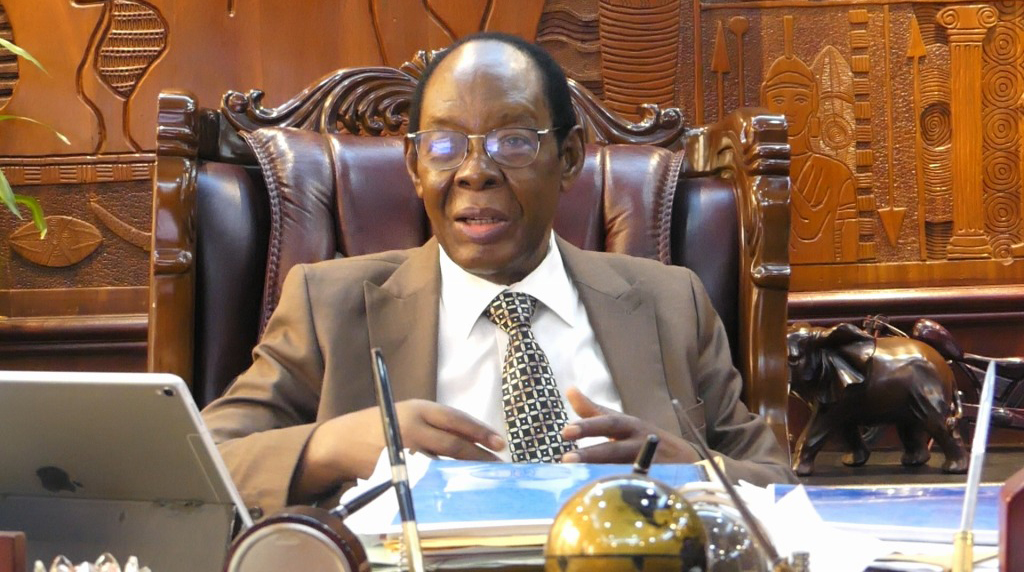
Veteran lawyer John Katende has revealed that he turned down an offer by President Museveni to serve as minister of Justice and Constitutional Affairs in the early 1990s, because he has never wanted to join politics.
Speaking to Bbeg Media at the offices of Katende, Ssempebwa & Company Advocates in Kampala, Katende said he has always preferred practising law to holding political office, despite his long-standing personal relationship with President Museveni.
“It is true that we have a personal relationship with President Museveni that dates back to our university days at the University of Dar es Salaam. He was studying Political Science while I was at the Faculty of Law,” Katende said.
Although he was a year ahead of Museveni at the Tanzanian university, Katende said they did not interact frequently. However, they shared a common love for Uganda and remained in touch over the years.
After completing his studies, Katende returned to Uganda and joined Makerere University as an assistant lecturer at the School of Law.
He said his academic performance and recommendations from his professors later earned him full scholarships to pursue postgraduate studies at Oxford University in the United Kingdom and Harvard University in the United States.
He chose Harvard.
Katende said he eventually chose to build his career in legal practice with Prof. Frederick Ssempebwa, who was a year ahead of him at the university.
According to his autobiography, My Life, the two lawyers believed that while teaching law was important, practical legal experience would make them better lecturers.
However, balancing university teaching with managing a law firm proved difficult. They therefore invited senior lawyer Cyprian Kawooya to oversee the day-to-day operations of the practice.
The firm was initially registered as Kawooya & Company Advocates before it later became Katende, Ssempebwa & Company Advocates, now widely known as KATS.
Katende disclosed that Museveni, at one point in the 1990s, wanted him to serve as minister of Justice and Constitutional Affairs. [WATCH VIDEO]
“I turned down the offer because I hate politics,” he said.
Instead, he said he chose to remain an independent legal practitioner.
Katende also described himself as a loyal supporter of Kabaka Ronald Muwenda Mutebi II, saying the Buganda Kingdom represents the culture, identity and heritage of the Baganda people.
He revealed that he used his personal relationship with Museveni to advocate for the restoration of traditional kingdoms, particularly Buganda, whose monarchy had been abolished by the Milton Obote government in 1966.
Katende said he was part of the delegation that held discussions with Museveni, leading to the restoration of the Buganda Kingdom.
He recalled that several meetings that laid the groundwork for the Kabaka’s coronation were held at his former law offices near the Bank of Uganda.
He added that, at the time, several key Buganda Kingdom properties, including Bulange and Mengo Palace, remained under military occupation, making negotiations particularly sensitive.
Katende said he is pleased that the Buganda Kingdom continues to attract young people and remains relevant to new generations.
He reiterated his long-standing support for a federal system of governance, arguing that it would allow Buganda to manage its own affairs more effectively while remaining part of Uganda.
Drawing on his experience as Buganda’s Attorney General, Katende said kingdom leaders consistently pushed for federalism because they believed it offered greater autonomy than the regional tier system that had been proposed.
“We preferred a federal arrangement because the regional tier was designed to weaken the Kabaka’s government at Mengo,” he said.
Over the years, Katende has built a reputation in several fields of legal practice, including immigration law, human rights, family law, international law, insurance law, labour and employment law, oil and gas law, media and entertainment law, privatisation, criminal law, environmental law, personal injury and torts, and debt recovery.
Yet beyond his legal career, he has also made significant contributions to Uganda’s arts and entertainment industry.
He founded The Ebonies in 1977, expanded into film production through Videography Cinematographics Limited (VCL), and later founded Theatre La Bonita.