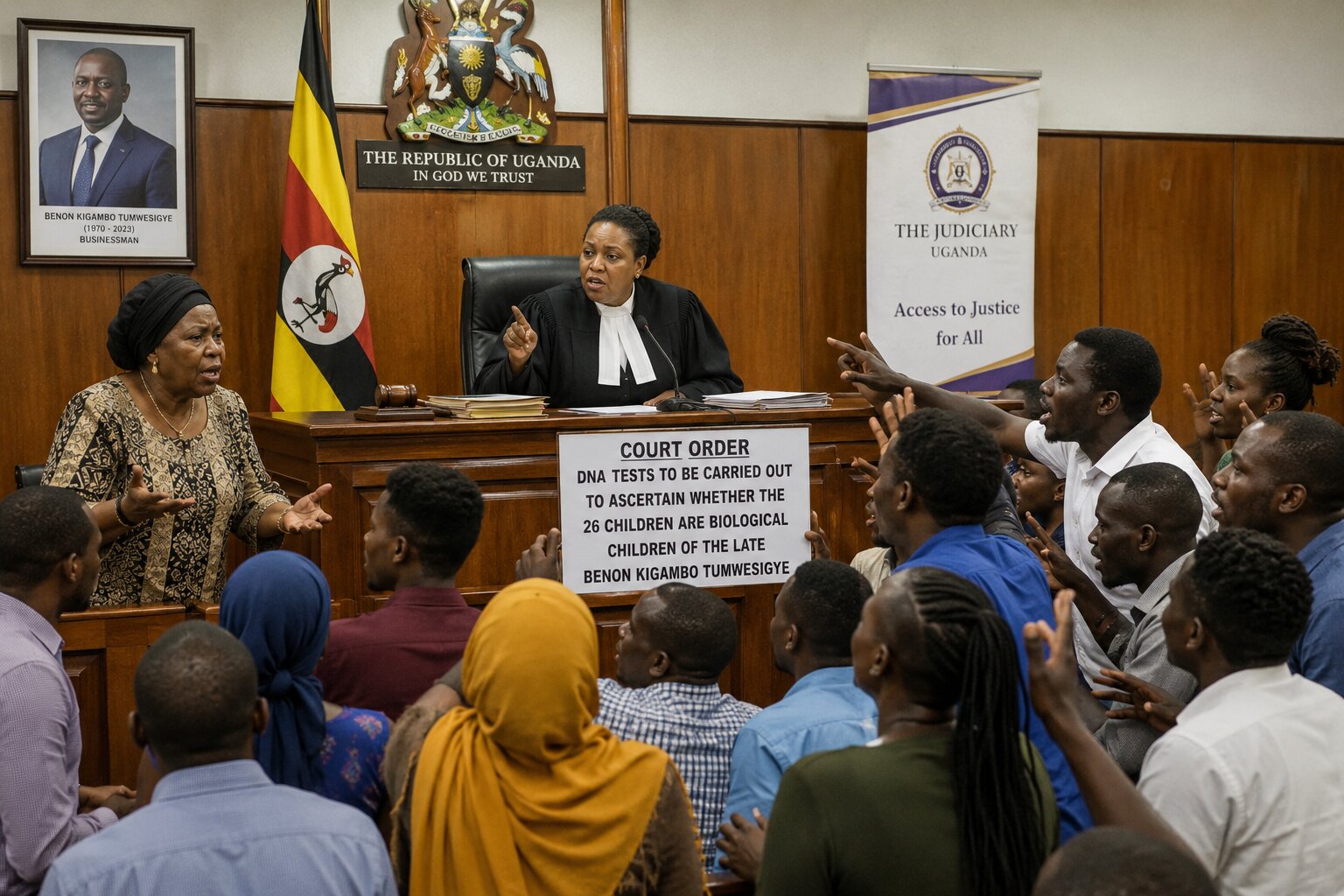
The High Court has ordered DNA tests for 26 people claiming to be children of the late Benon Kigambo Tumwesigye after a bitter family fight erupted over his estate following his death without a will.
Justice Celia Nagawa ordered that Tumwesigye’s remains be exhumed so government experts can conduct DNA tests to determine who his biological children are before his property is shared.
The case was filed by Maria Doreen Tumwesigye, who described herself as the widow of the deceased.
Benon Kigambo Tumwesigye died on June 14, 2022, without a will, which means he did not stipulate how his property should be distributed. He was a businessman with properties in Ntungama, Kampala and Wakiso.
According to the suit, the people listed as Tumwesigye’s children are Ronald Niwagaba, Gilbert Mwesigwa, Ssewava Winfred Karungi, Tumwesigye Trevor Troy, Tumwesigye Quin Shivan, Brolynn Murindwa, Brooke Murungi Tumwesigye, Tumwesigye Tyrone, Tumwesigye Tyra, Tumwesigye Rodney Manzi, Tumwesigye Nelia, Nicholas Asiimwe, Henry Mwesigye, Nyanjura Sky, Arinaitwe Gerald, Hillary, Komugisha Gemine, Immy Muhumuza, Glades Tumuhairwe, Benjamin Tumwesigye, Gloria Tukahirwa, Kenneth Muhairwe, Cynthia Tumwesigye, Conrad Tumwesigye, Chelse Tumwesigye and Collin Tumwesigye.
The widow told the court that during his lifetime, Tumwesigye privately expressed doubts about the paternity of some children, especially Ronald Niwagaba.
She argued that many of the alleged children were unknown to her during the marriage and that several only appeared during the burial arrangements after Tumwesigye’s death.
In her application, she asked the court to order sibling kinship tests before the estate could be distributed.
The widow, who was represented by lawyers from Elgon Advocates, further argued that as a surviving spouse, she was entitled to 20% of the estate under Uganda’s succession laws.
Lawyers from M/s Elgon Advocates represented Maria Doreen, while Ronald Niwagaba and the other respondents were represented by M/s
The respondents who were represented by ALP Advocates accused the widow of acting in bad faith.
Through an affidavit sworn by Winfred Ssewava Karungi, they argued that the widow herself had no right to challenge the children because she allegedly ceased being Tumwesigye’s wife years before his death.
They told the court that Tumwesigye had first married another woman identified as Theresa Tumukunde in a customary marriage in Ntungamo in 1982.
They produced documents from the United States claiming that Maria Doreen Tumwesigye divorced their late father in California in 2014 and later married another man identified as Lamont D. Jackson.
Therefore, they said, she is not entitled to claim the status of a surviving spouse of the deceased.
They also argued that forcing the children to undergo DNA tests would deepen divisions within the family.
They accused the widow of trying to reduce the number of beneficiaries so she could receive a bigger share of the estate.
Court grants Turkish man divorce after Ugandan wife deceived him over pregnancy
Justice Nagawa rejected the arguments of the children that the widow had no legal standing to bring the application.
She ruled that the children had failed to prove the alleged customary marriage between Tumwesigye and Theresa Tumukunde because no witness to the ceremony testified in court.
On the alleged California divorce, Justice Nagawa said the matter could not be conclusively determined at this stage because the authenticity and legal effect of the foreign documents had not yet been fully tested in court.
“The central issue in this application concerns the proper identification of the lawful beneficiaries of the estate of the Late Benon Kigambo Tumwesigye,” she said.
Justice Nagawa added that courts have a duty to ensure property is inherited by the correct beneficiaries, especially where a person dies without a will.
She acknowledged that ordering DNA testing in family disputes is sensitive and can emotionally damage families.
However, she noted that the circumstances of the Tumwesigye family dispute were unusual because of the high number of people claiming to be beneficiaries.
“Twenty-six individuals have come forward as beneficiaries of the estate, several born to different mothers, and several born outside of any formally proven marriage to the deceased,” she said, adding that scientific testing was the best way to establish the truth.
Justice Nagawa also said children have a constitutional right to know their parents.
In the end, she allowed the widow’s application and ordered DNA testing for all the respondents.
She directed that the tests should be carried out at the government analytical laboratory in Wandegeya and results submitted within one month.
Justice Nagawa ordered government pathologists to exhume Tumwesigye’s remains so samples could be obtained directly from the deceased.
She also stopped any distribution of the estate until the DNA results are produced and examined by the court.
She said the costs of the DNA exercise will be paid from the estate itself.