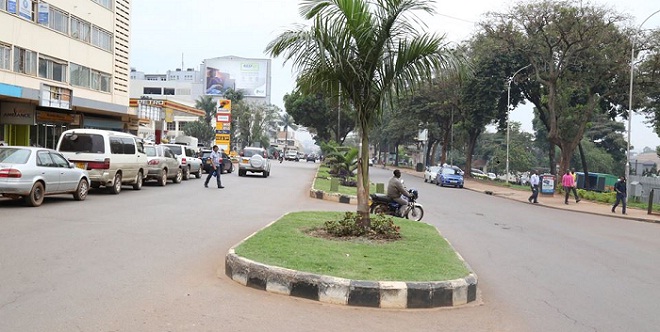
The Kampala Capital City Authority (KCCA) has suspended all on-street parking along two of the capital’s busiest roads, a move that will force thousands of people, private motorists, and the city’s vast commuter taxi fleet to rethink how they navigate the central business district.
The ban covers the full stretch of Kampala Road and Jinja Road between the Entebbe Road junction and the Jinja Road/Yusuf Lule junction at Kitgum House.
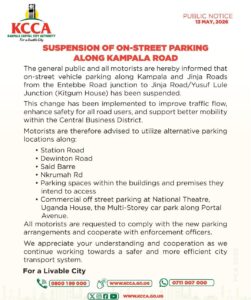
KCCA announced the measure in a public notice dated May 13, 2026, citing the need to improve traffic flow, enhance road safety, and support better mobility across the central business district.
The city authority did not indicate when they will start implementing the directive, leaving motorists uncertain whether the suspension is a temporary measure or a permanent change.
The decision is likely to cause significant disruption to operators of commuter taxis, which rely heavily on informal stopping and loading points along both roads to pick up and drop off passengers.
Kampala Road in particular serves as an unofficial transit corridor for routes connecting the city centre to suburbs including Ntinda, Bugolobi, Nakawa, Mukono, and Bweyogerere.
Without designated stages on the affected stretch, taxis risk fines or impoundment if they stop to load passengers, while people face the prospect of walking longer distances to get taxis.
In the brief notice, KCCA directed motorists to alternative parking locations, including Station Road, Dewinton Road, Said Barre Avenue, Nkrumah Road, as well as commercial vehicle parking facilities at the National Theatre, Uganda House, and the multi-storey car park along Portal Avenue.
Motorists were also encouraged to use parking within the private premises of buildings they intend to visit.
Kampala has an estimated 8,000 registered commuter taxi operators, while an estimated 2 million people transit daily through the city for work and business.