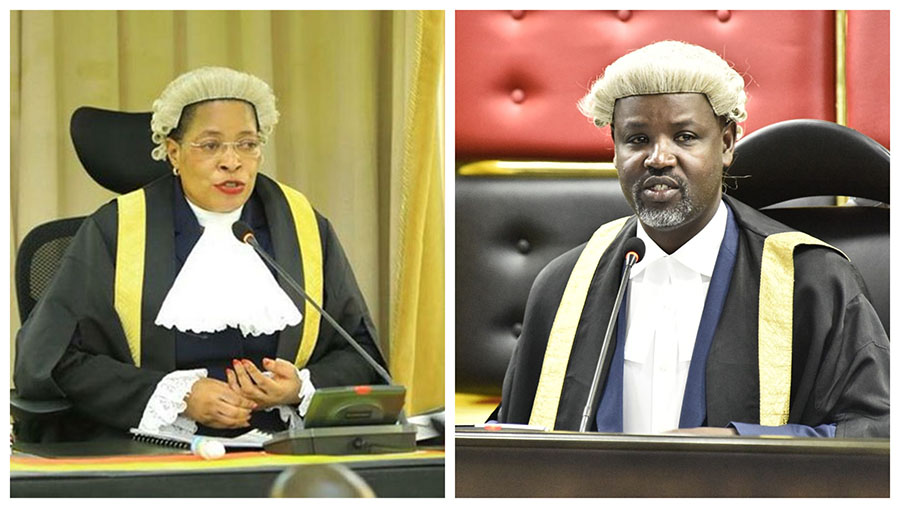
The High Court has dismissed an application filed by a one Jack Nsubuga, also known as Mandela, who had challenged the decision by the NRM to endorse Anita Annet Among and Thomas Tayebwa as the party flag bearers for the position of speaker and deputy Speaker of the 12th Parliament.
In a ruling delivered today, Justice Collins Acellam dismissed the case after finding that Nsubuga had no sufficient legal standing to bring the application and had also failed to exhaust the internal dispute resolution mechanisms within the ruling party before going to court.
The court, however, declined to award costs to any party.
The dispute arose from a January 29, 2026, meeting held at State House Entebbe, where the NRM Central Executive Committee endorsed Among for speaker and Tayebwa for deputy speaker of Parliament.
Nsubuga argued that the endorsement process was unfair and excluded other eligible members of the NRM Parliamentary Caucus from expressing interest in the two positions.
He claimed the process violated principles of democracy, equality, and participation within the party.
In his application, Nsubuga told the court that the NRM had transformed into a mass political organisation after a nationwide digital registration exercise launched around November 2024.
He argued that this growth required broader participation by party members in making major leadership decisions.
Nsubuga further argued that the endorsement process ignored proposals he had allegedly advanced regarding internal party electoral reforms and participatory leadership selection processes.
He also accused senior party officials of refusing to allow him to explain his ideas concerning democratic reforms within the NRM.
Nsubuga told the court that he had petitioned different offices and institutions both within and outside the NRM structures before Parliament was inaugurated, but his complaints were allegedly ignored.
He then asked the court to quash the endorsements, stop their implementation, and order a fresh participatory process.
Nsubuga represented himself in court.
The NRM, Anita Among, and Thomas Tayebwa all opposed the case.
The NRM was represented by lawyer Usaama Sebuufu from K&K Advocates. Among was jointly represented by Magna Advocates and Alaka & Company Advocates, while Tayebwa was represented by Ortus Advocates.

NRM argued that Nsubuga’s application was “incompetent, misconceived, frivolous, vexatious, and an abuse of the process of the Court.”
The party said Nsubuga had failed to use internal party mechanisms for resolving disputes before running to court.
The party maintained that CEC had lawful powers under the NRM constitution and Parliamentary Caucus Rules to recommend candidates for speaker and deputy speaker.
In her affidavit, Among also denied wrongdoing and argued that her endorsement was lawful.
She told the court that the allegations of impropriety, conspiracy, and illegality were speculative and unsupported by evidence.
Tayebwa similarly argued that the application was premature and disclosed no proper grounds for judicial review.
He insisted that the actions of the NRM CEC were lawful and undertaken within the party’s constitutional mandate.
In his ruling, Justice Acellam agreed with NRM, Among, and Taywebwa that Nsubuga lacked sufficient legal standing to file the case in the manner he did.
He noted that Nsubuga had claimed to be acting partly on behalf of 72,000 elected NRM LC1 chairpersons but had not obtained permission from the court to bring a representative action.
“No material has been placed before this court demonstrating that the Applicant obtained a representative order or lawful authority to institute these proceedings on behalf of the persons he purports to represent,” Justice Acellam said.
The judge further noted that Nsubuga was neither a Member of Parliament within the NRM Parliamentary Caucus nor a person shown to have been eligible for consideration for the offices of Speaker or Deputy Speaker.
“The doctrine of sufficient interest is intended to ensure that judicial review jurisdiction is invoked by persons genuinely and directly affected by the impugned process and not by persons raising abstract political grievances detached from a legally recognizable stake in the dispute,” the judge said.
Justice Acellam also agreed with the respondents that Nsubuga failed to exhaust the available internal dispute resolution mechanisms within the NRM before going to court.
He said the doctrine of exhaustion was now firmly embedded in Uganda’s judicial review framework.
He added that courts must avoid becoming the first forum for every internal political disagreement within parties.
“To hold otherwise would risk converting this court into the first forum for resolution of every internal political disagreement arising within political organisations notwithstanding the existence of constitutionally recognised institutional mechanisms established for that very purpose,” he stated.
Justice Acellam also stressed that courts are not supervisors of political strategy or internal caucus preferences.
“Courts are guardians of legality, not supervisors of political strategy or internal caucus preferences,” he ruled.
In the end, Justice Acellam dismissed Nsubuga’s application, but he declined to award costs against him despite dismissing his case.
“Considering that the application raised questions touching on constitutional governance, internal political democracy, and the scope of judicial review jurisdiction in relation to internal political party processes, I am of the considered view that this is not an appropriate case for an award of costs,” he ruled.