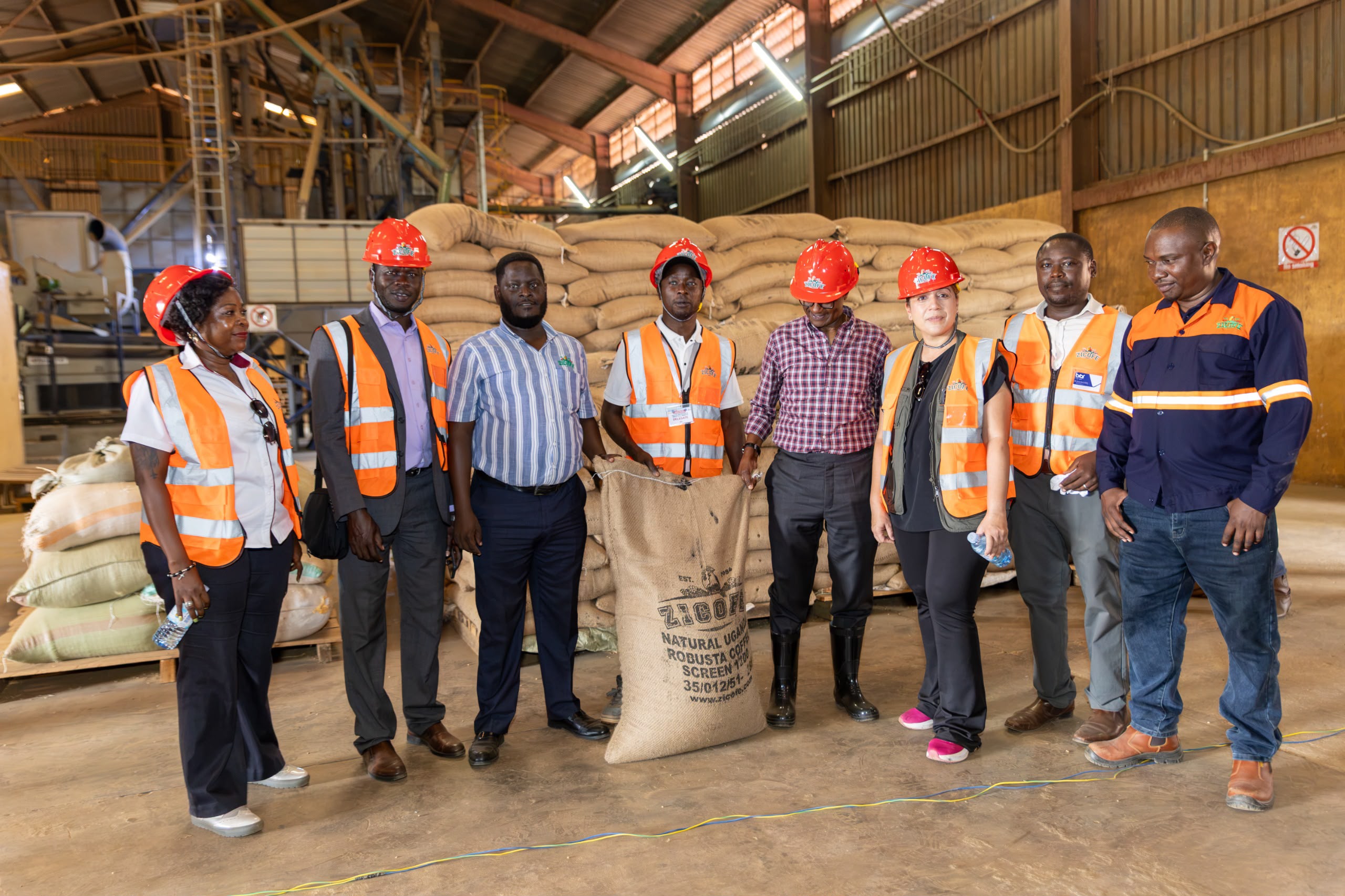

Agriculture Minister Frank Tumwebaze has urged coffee and cocoa farmers not to panic over the recent fall in prices, saying the decline is largely linked to changes in global supply and market expectations rather than a collapse in demand.
In a statement issued on September 20, Tumwebaze said coffee and cocoa are internationally traded commodities whose prices in Uganda are affected by production, stocks, weather, shipping costs, currencies and consumption in major producing and consuming countries.
“The current price fluctuation should not be interpreted as a disappearance of demand for coffee or cocoa,” Tumwebaze said. “It is largely a response to changing expectations in global supply and inventories.”
The minister said the recent pressure on coffee prices has been partly caused by increased supplies from Brazil and Vietnam, two of the world’s major coffee producers.
Brazil’s harvest has been coming onto the international market, while increased exports from Vietnam have added more Robusta coffee to global supplies. Expectations of higher global coffee production in the 2026/27 season have also put pressure on prices.
The effect is already being felt by Ugandan farmers.
According to price information from the Ministry of Agriculture, Animal Industry and Fisheries, the average farm-gate price of Robusta FAQ coffee fell from between Shs13,500 and Shs14,000 per kilogramme in September last year to between Shs11,500 and Shs12,000 per kilogramme during the first half of September this year.
Using the midpoint of the two price ranges, the ministry estimates that the price has fallen by about 14.5%
Robusta Kiboko has also fallen from between Shs6,000 and Shs7,000 per kilogramme last year to between Shs5,000 and Shs6,000 this month.
However, Tumwebaze said not all coffee prices have fallen.
Arabica parchment has moved in the opposite direction, rising from about Shs14,000 to Shs15,000 per kilogramme in September 2025 to between Shs15,500 and Shs16,000 per kilogramme in September 2026.

Tumwebaze said the pressure on Uganda’s coffee sector is being made worse by drought and unusually high temperatures in some major coffee-growing areas. The affected areas include Greater Masaka, Kyotera, Sembabule and Luwero.
In affected areas, the ministry estimates that adverse weather has reduced coffee out-turn by about 10%.
Uganda exported 846,376 bags of coffee (of 60kg each) in July 2026. This was down from 997,105 bags exported in July 2025, representing a fall of about 15%
Export earnings also fell from $250.7 million in July 2025 to $204.1 million in July 2026, a decline of about 18.6%
Tumwebaze, however, said farmers should not automatically regard a fall in the selling price as a loss.
“A price decline is not the same thing as making a loss,” he said, explaining that profitability depends on production costs, productivity per acre, coffee quality and post-harvest handling.
He said ministry calculations show that organised farmers who improve productivity and carry out basic value addition can still break even when the price of FAQ coffee is about Shs7,000 per kilogramme.
He also cautioned farmers against harvesting immature coffee in an attempt to get quick money.
He said traders are increasingly rewarding farmers who supply properly harvested, dried and graded coffee, while poorly dried, immature or mixed coffee attracts lower prices.
“Do not panic. Do not harvest immature coffee. Do not compromise quality,” Tumwebaze said.
He encouraged farmers to move away from selling raw Kiboko where possible and improve the processing and grading of their coffee to increase their earnings.
Meanwhile, he said cocoa had also experienced a sharp decline in international prices after earlier increases.
Tumwebaze attributed part of the decline to expectations of increased global supplies, including a reported 30% increase in Ivory Coast’s cocoa harvest during the June 2025 to June 2026 season.
He said higher cocoa shipments and increased global inventories have also contributed to the downward movement in prices.
Tumwebaze said the government expects coffee and cocoa prices to become more stable as global supply and weather conditions change over the coming months.
.