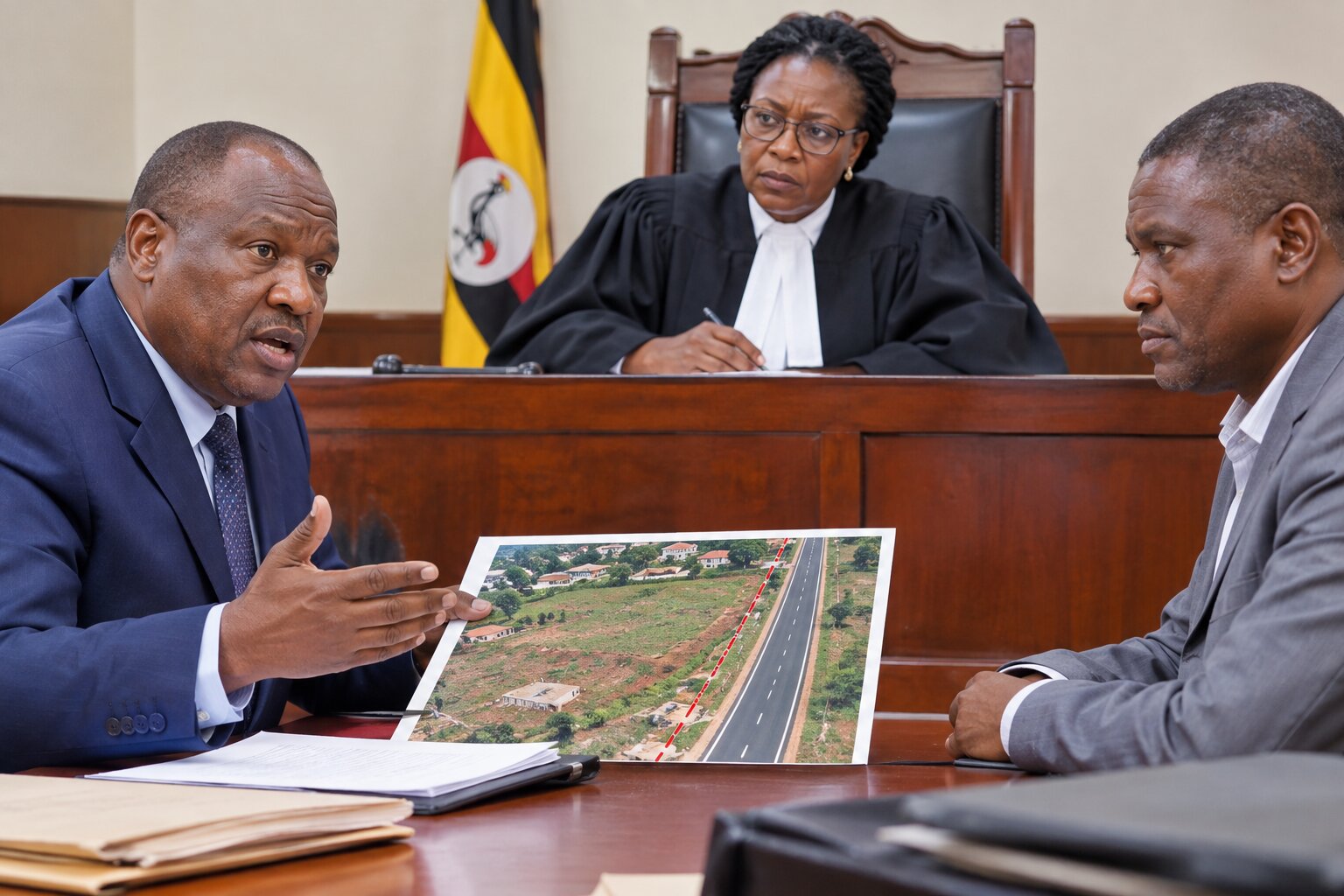
The High Court has dismissed a case by city businessman Dennis Ssengendo, who wanted to cancel a consent judgment in a land dispute with Josiah Muita, after he complained that part of the land he bought at Kireka was actually occupied by an existing road.
Justice Patricia Kahigi Asiimwe ruled that Ssengendo had failed to prove that Muita misrepresented the size of the land or concealed important information before the parties entered into their settlement.
The dispute centred on a small piece of land at Kireka measuring 9.9 decimals, which Muita sold to Ssengendo for Shs346 million.
Ssengendo later developed the property, and the value of those developments was assessed at Shs89 million, which was deducted from the purchase price, leaving a balance of Shs257 million.
Muita later sued Ssengendo to recover the outstanding Shs257 million; however, before the case could proceed, the two sides agreed to settle the matter through a consent judgment.
Under the agreement, Ssengendo agreed to pay Muita a total of Shs353.779 million. In return, Muita was to release the duplicate certificate of title and transfer documents into Ssengendo’s name.
However, Ssengendo returned to court this time seeking to set aside the consent judgment and stop any attempts to enforce it.
He argued that he had been led to believe that the land measured 9.9 decimals, but when a boundary opening exercise was carried out on April 8, 2026, it was revealed that the land measured 7.6 decimals because a portion of it was a road.
Ssengendo therefore argued that the consent judgment had been obtained through misrepresentation, concealment of material facts, and non-disclosure by Muita.
But Muita, through his lawyers, Astral Advocates, argued that Ssengendo and his lawyer had participated in the negotiations that produced the consent judgment and were fully aware of its contents.
He maintained that the consent was entered into voluntarily and that there had been no coercion, pressure, mistake, fraud, concealment or misrepresentation.
Muita also pointed to Ssengendo’s failure to comply fully with the agreed payment schedule because under the agreement, he was supposed to pay Shs200 million as the first instalment by June 30, 2025.
Instead, according to Muita, he paid only Shs120 million, leaving Shs80 million outstanding.
Muita further argued that the complaint about the size of the land had been raised for the first time after execution proceedings had started.
He told the court that any problem concerning the title could be dealt with by the land registry and was not enough reason to cancel the consent judgment.
He also argued that Ssengendo had been in possession and had used the property since 2022, meaning he had already benefited from the transaction.
In her ruling, Justice Asiimwe, citing the case of Hirani v Kassam, said an order made with the consent of lawyers is generally binding on the parties and cannot simply be changed or cancelled unless there are recognised grounds such as fraud, collusion, or an agreement contrary to court policy.
She noted that Ssengendo had had the property since 2022 but only carried out the boundary opening exercise in April 2026, about four years later.
Justice Asiimwe said a person buying land is expected to carry out due diligence, including checking the physical features and boundaries of the property before completing the transaction.
“Due diligence requires an intending purchaser to verify physical features and boundaries before contracting,” she ruled.
She questioned Ssengendo’s claim that he only discovered the road problem years after taking possession, saying it was “improbable” that he was unaware of a visible existing road on land that he had personally possessed for four years.
Justice Asiimwe stated that any administrative discrepancies or adjustments involving boundary alignments and acreage fall within the statutory powers of the land registry to rectify.
In other words, she said that even if there was a problem concerning the physical boundaries or the amount of land affected by the road, that issue did not automatically mean that the consent judgment should be cancelled.
She ultimately found that Ssengendo had not proved that Muita had misrepresented the land, concealed important information or failed to disclose material facts and dismissed the case.
Justice Asiimwe ordered Ssengendo to meet the costs of the application.