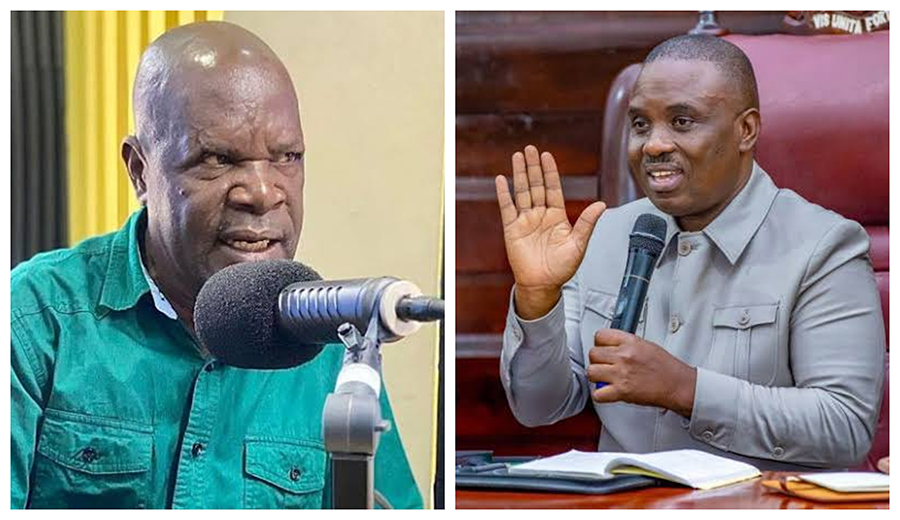
A political argument on NBS TV that former lord mayor Lukwago Erias said turned into a frightening physical attack has ended with the High Court ruling that the alleged assault was not proved.
Justice Bonny Isaac Teko has dismissed a case in which Lukwago accused former government spokesman Ofwono Opondo of attacking him in July 2022.
Lukwago wanted the court to declare that Opondo had violated his constitutional rights, award him damages, order Opondo to publicly apologise and pay his legal costs.
Instead, the court said Lukwago had failed to prove that he had been tortured, assaulted in a manner that amounted to a constitutional violation or unlawfully deprived of his freedom.
The dramatic dispute began on the evening of July 28, 2022 when Lukwago and Opondo appeared together as panellists on NBS Television’s Frontline programme.
The show was discussing the Soroti East parliamentary by-election.
According to Lukwago’s version of events, the debate became heated midway through the programme and Opondo suddenly got out of his seat and charged towards him.
Lukwago alleged that Opondo threatened to have him thrown out of the studio before he pushed his hand into his pocket “in a manner suggestive of drawing of a pistol”.
Lukwago then alleged that Opondo grabbed him by his jacket, pulled him from his chair, punched him in the chest and kicked him in the stomach.
After the show, Lukwago claimed Opondo continued threatening to “finish him off” in the corridors of the television station.
According to Lukwago, NBS management became so concerned about his safety that he was locked in a separate room until police arrived at about 1am and escorted him home.
Lukwago’s lawyers, from his law firm Lukwago & Co. Advocates, argued that their client had suffered a serious violation of his constitutional rights.
They argued that being attacked publicly, in front of fellow panellists and viewers, was humiliating and degrading.
They told the court that Lukwago was not simply another member of the public. He was lord mayor of Kampala, a former MP, and a practising advocate.
His lawyers argued that Opondo’s conduct had left Lukwago “defenceless, humiliated, and in pain”.
But Opondo denied punching, kicking or physically attacking Lukwago.
Instead, he said Lukwago had been aggressive from the beginning of the programme, repeatedly interrupting him when it was his turn to speak and making inflammatory accusations.
Among them, Opondo said, was an allegation that he had previously shot someone, which he described as false.
Opondo was represented by lawyers from K&K Advocates who said the burden was on Lukwago to prove his allegations on a balance of probabilities.
They argued that serious allegations could not simply be accepted because they appeared in an affidavit.
They pointed out that there was no medical evidence, no medical report, no photographs showing injuries and no independent witness statement from the people who were allegedly present.
The studio had the programme host, fellow panellists, producers, camera operators and security personnel.
Yet, Opondo’s lawyers noted, none had been called to support Lukwago’s account.
Then came the video, a two-minute, 44-second clip downloaded from YouTube which Lukwago had presented as evidence.
Opondo’s lawyers argued that the video actually damaged Lukwago’s case.
They said the footage showed a “heated verbal exchange” and that Lukwago appeared aggressive and combative, but did not show Opondo punching, kicking or physically assaulting him.
Regal Paints loses tax battle with URA over Dr Fixit imports
Justice Teko agreed that the video showed that something heated had happened but did not prove the physical attack alleged by Lukwago.
“The footage depicts a heated verbal exchange between the parties and a tense atmosphere during the televised debate,” he said.
However, he added that the court was unable to discern any clear act of punching, kicking, or physical assault as specifically pleaded by Lukwago.
Justice Teko also rejected Lukwago’s argument that Opondo was responsible for his alleged confinement at the NBS premises.
He said there was no evidence that Opondo had instructed, directed or participated in any decision to restrain Lukwago.
In the end, the court found that Lukwago had failed to prove his case and Justice Teko said the evidence disclosed ” was at most, an altercation whose circumstances remained insufficiently established”.
He noted that Lukwago had withdrawn NBS TV from the case even though the station could have provided important independent evidence.
No other panellist testified. No CCTV footage from the studio or corridors was produced. There was no medical evidence showing serious injuries.
“It would be difficult to imagine a situation of unhinged mayhem and anarchical waywardness in which Opondo could have had Lukwago by the collar while the station, panellists, security officers and production team simply stood by,” he ruled.
He likened the alleged scene to an “‘OO’ action movie” unfolding “like an American Wild Western Flick”, yet with no physical slapping, kicking or assault appearing on the available footage or CCTV.
Justice Teko concluded that the confrontation did not cross the constitutional threshold for torture or inhuman and degrading treatment and dismissed Lukwago’s application.
He ordered each party to pay their own costs, saying the dispute arose from a public television debate on public issues.