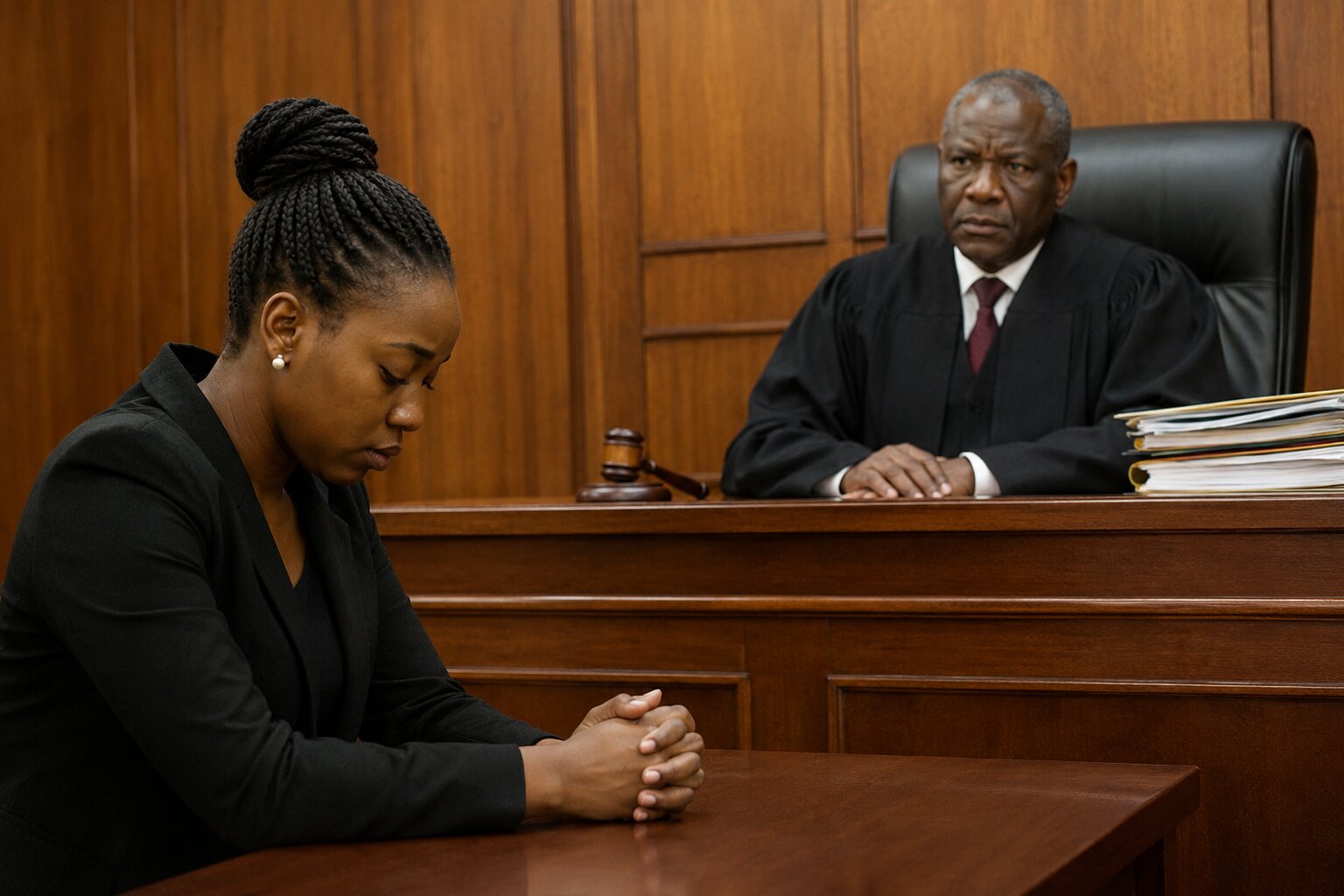
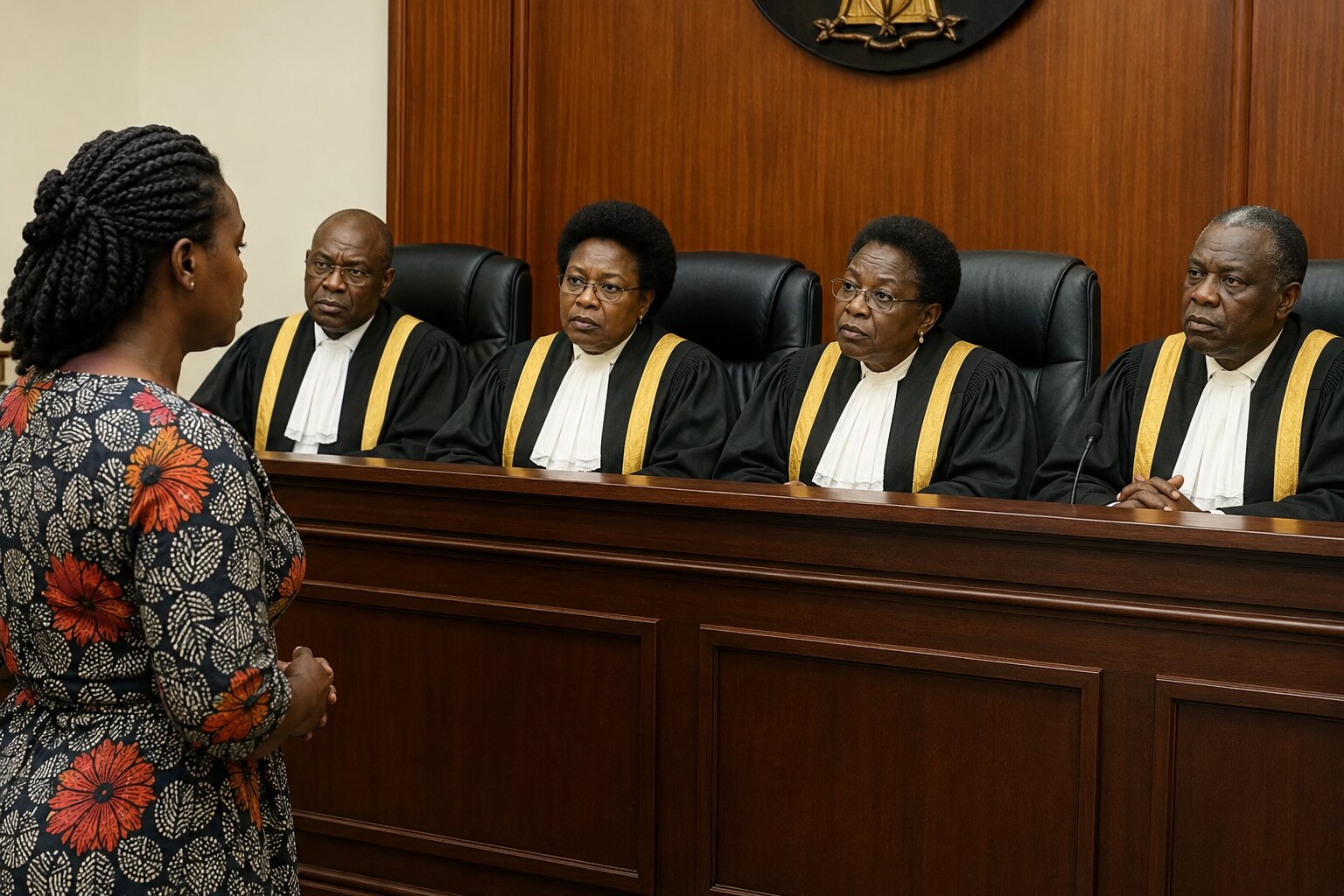
Jackline Nakku, who had been sentenced to 20 years for allegedly killing her husband in 2018, has been freed by the Supreme Court, which said the evidence used to convict her was not strong enough to prove beyond reasonable doubt that she participated in the killing of her husband.
The five justices of the court unanimously quashed her conviction and ordered that she be set free immediately unless she is being held on another lawful charge.
The ruling brings to an end a case that began with the death of Nakku’s husband, Eric Ssenyonjo Kiddu, at their home in Upper Nabuti, Mukono, on the night of February 13, 2018.
Nakku and Ssenyonjo had started dating in February 2013 and married on January 3, 2015. They had two young children.
But the marriage developed issues after Nakku discovered that Kiddu was having an affair with a tenant identified as Imme. The couple later moved to their unfinished home in Upper Nabuti to reduce their disagreements.
Their problems, however, continued. They developed disagreements over Nakku’s job at Kazi Foods Logistics and her studies at Kyambogo University.
At one point, Nakku said her husband confronted her employers and forced her to choose between her marriage, education, and career. She eventually resigned her job.
In August 2017, she travelled to Tanzania looking for another job, leaving the children with their father.
When she returned to Uganda, Nakku went to the Mukono Probation Office in November 2017 to seek help accessing her children.
The probation officer mediated between the couple, and they agreed to return to their matrimonial home but sleep in separate bedrooms while trying to repair their relationship.
The arrangement meant Kiddu slept in the master bedroom while Nakku slept on a mattress on the floor of the visitors’ bedroom. She sometimes moved the mattress into the master bedroom.
Then came the night of February 13, 2018.
The couple had spent the day preparing for the birthday of their eldest child, who was due to turn four. Nakku visited the child’s school and bought two cakes from Mukono Bakery. She later returned home with her friend, Stella Nakibuka.
Ssenyonjo arrived at about 6.30 pm carrying milk and eggs, and the family ate together.
At about 9.30 pm, Nakibuka left. A neighbour, a man named Tonny, then invited Kiddu to watch a football match at a nearby bar. Ssenyonjo returned home at about 12.30 am on February 14.
Nakku opened the metallic side door for him. Their younger child, Adrian, was crying in the children’s bedroom, and the housemaid, Evelyn Aketto, was awake looking after him.
Nakku helped with the child and then went with Kiddu to the master bedroom, leaving him to secure the outside door.
Nakku says she was woken by a loud bang from her husband’s bed. She said that when she looked up, she saw two unidentified men attacking Kiddu.
According to her account, she ran out of the bedroom and then out of the house to look for help from neighbours. She said she did not wake the housemaid or the children because she feared that doing so would attract the attackers’ attention to them.
Nakku ran to a neighbour, Jjaja Bridget, who tried unsuccessfully to call the police emergency number, 999. Bridget then contacted Nakku’s mother before suggesting that they seek help from Andrew Nalume, a neighbour who was also a police officer.
Nalume came with his wife and other neighbours. They blew whistles to raise an alarm.
When they returned to the compound, Nalume threw a brick at the front glass door to establish whether the attackers were still inside. The brick broke a small section of the glass.
The housemaid eventually came out with the three children. One of the children, Charity Namusoke, told the people outside that her father was dead in the bedroom.
Neighbours and police entered the master bedroom and found Kiddu lying face down on the bed in a pool of blood.
A post-mortem examination carried out by Dr Sam Katungi found that Kiddu had died from severe blunt force trauma to the head. He had suffered a skull fracture and brain injuries.
Police recovered several objects from the scene. Among them was a panga, which tested negative for blood and was therefore ruled out as the murder weapon.
They also recovered an iron bar from the matrimonial bed. It had human blood matching Ssenyonjo’s DNA and was identified as the primary murder weapon.
However, forensic testing found no trace of DNA belonging to Nakku on the iron bar. Police also did not carry out blood-spatter analysis on the clothes Nakku had worn that night.
At the High Court in Mukono, the prosecution relied heavily on the couple’s troubled marriage and evidence from Kiddu’s relatives.
Kiddu’s mother, Fridah Natwoga, claimed Nakku had been unfaithful and told the court that her son had previously complained that Nakku poisoned his food.
Kiddu’s brother, Musoke Wycliffe, also told the court about an earlier incident in which he said Nakku had attempted to strangle Ssenyonjo.
But none of the witnesses from the deceased’s relatives or neighbours had actually seen Nakku participate in the killing.
Justice Susan Okalany nevertheless convicted Nakku in June 2019, ruling that although the prosecution had not proved that Nakku physically hit her husband, she had acted together with the attackers by opening the side door and failing to alert the housemaid or protect her husband.
She also considered Nakku’s calm appearance after the killing and the fact that she was wearing slippers when she ran outside as signs that the attack had been planned.
Nakku was sentenced to 20 years in prison. After deducting one year and three months spent on remand, she was left with 18 years and nine months to serve.
Nakku appealed to the Court of Appeal, arguing that Justice Okalany had relied on speculation rather than proper evidence.
But on December 13, 2023, the Court of Appeal dismissed her appeal and upheld both the conviction and sentence.
She then took the matter to the Supreme Court.
At the Supreme Court, Nakku’s lawyer, Dauda Walugembe of Hital & Co Advocates, argued that the entire prosecution case depended on circumstantial evidence and that such evidence had to exclude every reasonable explanation consistent with Nakku’s innocence.
He argued that the lower courts had wrongly assumed that because the metallic door had no signs of forced entry, Nakku must have opened it for the killers.
There were other possible explanations, he said, including the possibility that Ssenyonjo himself failed to lock the door after returning home or that another occupant had left it unlocked.
He also attacked the credibility of the deceased’s relatives, arguing that some of their claims were either uncorroborated or contradicted by scientific evidence.
Walugembe further argued that the prosecution’s failure to call the housemaid, Aketto Evelyn, was significant because she was an adult who was inside the house when the attack happened.
The state disagreed, and the prosecutors argued that circumstantial evidence could be sufficient to prove guilt and that the absence of forced entry, together with Nakku’s conduct after the killing, pointed to her guilt.
The state also argued that Nakku did not need to physically kill her husband to be liable under the law on common intention because she had allegedly facilitated the crime.
Equity Bank defeats Dei Industries bid to halt independent audit in loan dispute
But the Supreme Court justices rejected that reasoning from the state.
The justices, Prof Lilian Tibatemwa Ekirikubinza, Night Percy Tuhaise, Cristopher Izama Madrama and Muzamiru Kibeedi, said the lower courts had turned suspicion into proof.
“It is entirely plausible that the deceased himself failed to engage the internal bolts or lock the padlock,” the judges said, adding that “it is equally plausible that the entrance was left unfastened by another occupant.”
They stressed that in a case based on circumstantial evidence, the prosecution had to eliminate reasonable explanations consistent with innocence.
The judges also criticised the failure to call Aketto, the maid, to testify, saying she was best positioned to clarify whether the door was locked, whether she heard intruders, and whether Nakku raised an alarm.
The state had explained that the housemaid was untraceable, but the judges rejected that explanation because police had already recorded her statement.
The judges also found that the prosecution had failed to establish that Nakku shared a criminal plan with the unidentified attackers. They noted that none of the alleged attackers had ever been identified or arrested.
They also questioned why Nakku’s account that she had seen two men attacking her husband was not believed.
In the end, the Supreme Court found that the prosecution evidence did not reach the required standard and therefore quashed Nakku’s murder conviction and sentence.
The justices said they regretted that the system had failed Nakku, noting that she had told the court in June 2026 that she had about four years and 10 months left on her sentence.