
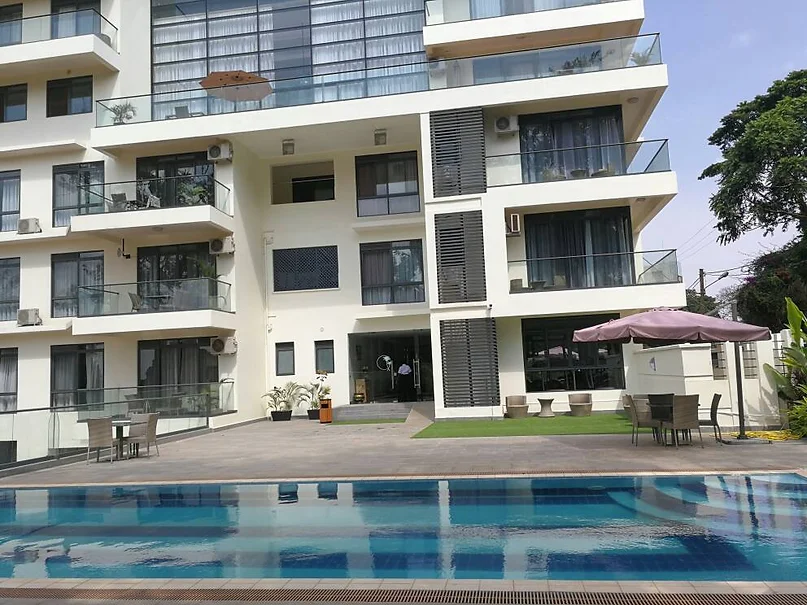
The phrase “serviced apartment” became the centre of a tax dispute between businessman Sharad Karia and the Uganda Revenue Authority (URA), after the tax body argued that apartments he rented out in Kampala were not ordinary residential properties but serviced apartments whose income was liable to Value Added Tax (VAT).
The dispute eventually reached the High Court Commercial Division in Kampala, where Justice Dr Ginamia Melody Ngwatu had to decide whether Karia’s Royal Palms Apartments at Plot 1A Baker Road, Nakasero, were being leased as immovable property or whether the extra facilities and services offered to tenants turned it into a serviced apartment for VAT purposes.
The case started on 19 May 2022 when URA issued Karia with an administrative additional tax assessment of Shs230.7 million.
Karia objected to the assessment, but URA rejected his objection on March 16, 2023, and maintained that the property was a serviced apartment and that the income from it attracted VAT.
Karia then went to the Tax Appeals Tribunal (TAT), challenging URA’s decision, but the tribunal sided with URA.
Dissatisfied, he appealed to the High Court, arguing that the tribunal had made errors of law in treating his property as a serviced apartment and in finding that his business did not amount to ordinary leasing or letting of immovable property.
The argument over the words “serviced apartment” became important because the VAT Act excludes the leasing or letting of serviced apartments from the general VAT exemption given to immovable property.
Under paragraph 1(f) of the relevant schedule, leasing or letting of immovable property is generally exempt from VAT, except for categories including commercial premises, hotels or holiday accommodation, short-term leases, parking or storage facilities and “a lease or letting of serviced apartments”.
The problem for both sides was that the VAT Act does not define what a serviced apartment is.
Karia’s lawyers argued that this omission was important. They said the tribunal had effectively created a definition which Parliament itself had not provided. They argued that tax laws must be clear before a taxpayer can be required to pay tax.
The lawyers submitted that “the VAT Act does not define the term ‘service apartment’” and that the provision was therefore ambiguous.
They argued that the tribunal “should not have attempted to legislate a definition for the term” because the power to make laws belonged to Parliament.
They also maintained that his apartments were long-term residential apartments, not serviced apartments. They challenged the tribunal’s reliance on the idea of “active” and “passive” exploitation of property, arguing that this concept was not expressly contained in Uganda’s tax laws.
They further attacked the tribunal’s reliance on foreign law to explain why ordinary leasing of property should be exempt from VAT.
They argued that Parliament had not provided a similar explanation in the Hansard, so the tribunal had no proper basis for importing the reasoning behind foreign legislation into Uganda’s VAT law.
URA took the opposite position and argued that the tribunal was right to classify Karia’s property as serviced apartments and therefore outside the VAT exemption.
The lawyers of the tax body said the important question was not simply whether the apartments were residential, but whether tenants received additional value through furnishings, amenities, accessories and other services.
URA’s lawyers pointed to facilities such as security and other services provided to tenants. They also relied on the fact that service charges were imposed in addition to rent, arguing that this showed the apartments were more than simply empty properties being handed over to tenants.
It further argued that tax exemptions must be interpreted strictly, saying Karia had failed to prove that the apartments were not serviced apartments and therefore fell within the VAT exemption.
URA relied on section 11 of the VAT Act, which defines the supply of services to include “the making available of any facility or advantage”.
It also argued that the length of time tenants stayed in the apartments was not the main issue. What mattered, it said, was the economic reality of the arrangement.
The tax authority pointed to furnishings, amenities, accessories, facilities and services provided by Karia, arguing that these amounted to additional services under the VAT Act.
Karia’s lawyers pushed back, saying the service charge was not evidence that Karia was operating serviced apartments because the charge was imposed by Property Service Ltd, the company managing the property.
They also argued that some tenancy agreements treated rent and service charges differently and that not all rental agreements included VAT on rent.
They also argued that the question of whether furnishings and household amenities amounted to “value addition” was a question of fact, yet the High Court appeal from the tribunal was limited to questions of law.
Absa Bank ordered to pay engineer Shs 14 million over unfair sacking
Justice Ngwatu first considered whether the tribunal had been wrong to say that Karia’s business did not constitute leasing or letting of immovable property and agreed with him on this point.
He noted that under the VAT Act, leasing or letting of immovable property is generally exempt from VAT, subject to specified exceptions. He said the law showed that “the use of the property is the determinant as to whether the property is subject to VAT.”
Justice Ngwatu therefore found that the tribunal had made an error of law when it held that Karia’s business did not constitute leasing or letting of immovable property.
“This ground, therefore, succeeds,” she ruled.
But Karia did not win the more important battle over the term “serviced apartment”.
Justice Ngwatu considered the facilities available to tenants, including a gym, security, a 24-hour reception desk and, in some agreements, internet access.
In some tenancy agreements, Karia was responsible for utilities while tenants paid a service charge that included VAT.
She concluded that the provision of such facilities and services went beyond an ordinary landlord-tenant relationship.
“I am persuaded by the submissions of the respondent that the provision of furnishings, amenities, accessories and facilities constitutes making available facilities and performance of services under the Value Added Tax Act,” she said.
Justice Ngwatu concluded that the totality of the services provided by the appellant at the suit property cannot be compared to a mere landlord-tenant relationship.
She therefore upheld the finding that Karia’s property was a serviced apartment for purposes of the VAT law.
Shs also rejected the suggestion that a term automatically becomes ambiguous simply because Parliament has not defined it.
In the end, Karia won one ground of appeal and lost the other. She ordered that Karia be awarded half the costs of the appeal.
The ruling gives Karia a partial legal victory, but it does not amount to a complete victory over URA’s VAT position.
All in all, Justice Ngwatu agreed that the property was being leased as immovable property, but she also agreed with URA that the additional facilities and services provided to tenants meant the property fell within the statutory category of serviced apartments.