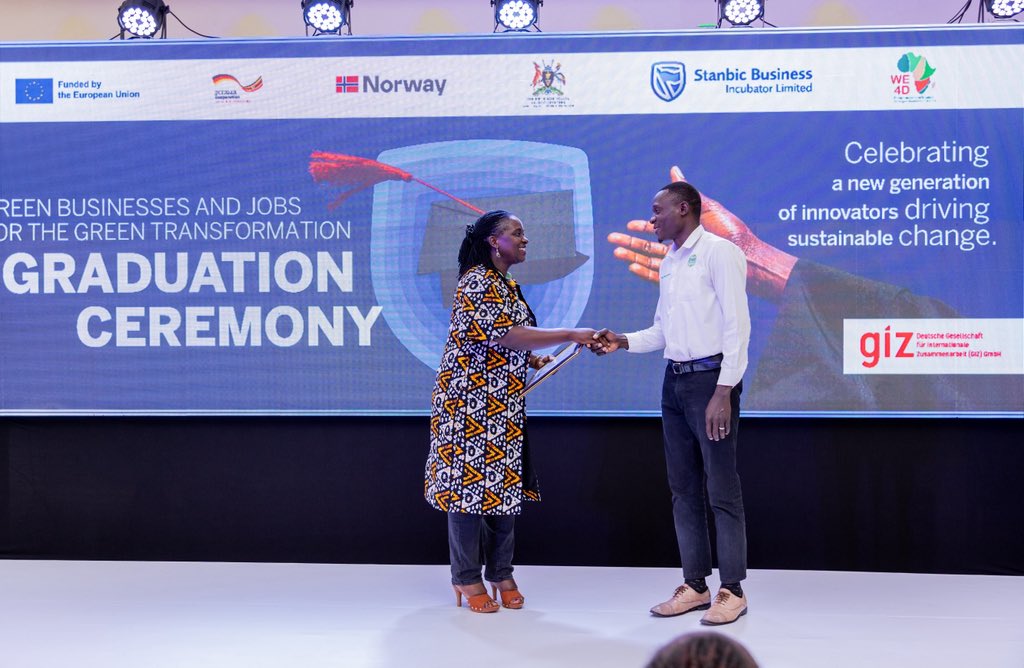
A total of 165 women-led enterprises have graduated from the Green Businesses and Jobs for the Green Transformation Project, a programme aimed at strengthening women entrepreneurship, creating green jobs and supporting Uganda’s transition to a sustainable economy.
The graduates completed Cohorts One to Four of the programme, which is implemented by Stanbic Business Incubator Limited (SBIL) in partnership with the German development agency GIZ and the Ministry of Gender, Labour and Social Development.
Launched in 2024 under the Women for the Green Transformation in Africa (WE4D) initiative, the programme supports women-owned businesses operating in renewable energy, the circular economy, waste management, sustainable agriculture, the blue economy and ecotourism.
Speaking at the graduation ceremony, the State Minister for Gender, Labour and Social Development, Ms Mary Kuteesa, represented by Assistant Commissioner for Equity and Rights Lydia Nabiryo, said empowering women entrepreneurs is critical to achieving Uganda’s Tenfold Growth Strategy.
“Uganda’s Tenfold Growth Strategy will only be realised if we deliberately invest in women-led enterprises that are creating jobs, driving innovation and contributing to environmental sustainability. These businesses demonstrate that women are actively shaping the country’s future,” she said.
She added that green businesses are creating jobs, improving household incomes and protecting the environment while contributing to inclusive economic growth.
The graduates underwent months of business training, coaching, workshops and investment readiness support to help them become more competitive and attract financing.
SBIL Chief Executive Officer Catherine Poran said the programme attracted more than 400 applications. Out of these, 200 enterprises were shortlisted and 165 successfully completed the training, representing an 82 per cent completion rate.
“This graduation demonstrates what can be achieved when we invest in women entrepreneurs and provide practical business support. These enterprises are creating jobs, strengthening local economies and building sustainable businesses ready for growth and investment,” Poran said.
She added that the programme reflects Stanbic’s commitment to supporting women, youth and farmers through enterprise development.
Michael Seng, the WE4D Programme Lead at GIZ, said women-led green enterprises have the potential to create jobs, reduce environmental degradation and build resilient local economies.
The broader WE4D programme is jointly funded by the Government of Norway and the European Union and is being implemented in Uganda, Kenya and Tanzania.
Judith Kibuuka who represented Stanbic Uganda Holdings chief executive Mark Ocitti, said Stanbic and its partners have committed Shs 1 trillion towards financial inclusion, enterprise development, infrastructure investment, climate resilience financing and corporate social investment.
Among the graduates, Anne Kayiwa, founder of Papillon Living, said the mentorship changed her understanding of business growth.
“We realised our biggest challenge was not money but knowledge on how to run, manage and formalise our businesses,” she said.
Joan Muchiruka, founder of Iroma Honey, said the programme inspired her to pursue government certification and expand her business.
The assistant commissioner for Training and Business Skills Development at the Ministry of Trade, Johnson Abitekaniza, urged the graduates to maintain quality standards and improve customer service.
“Many businesses advertise products on social media but take days to respond to customers. Growth depends not only on financing but also on efficient operations and good customer care,” he said