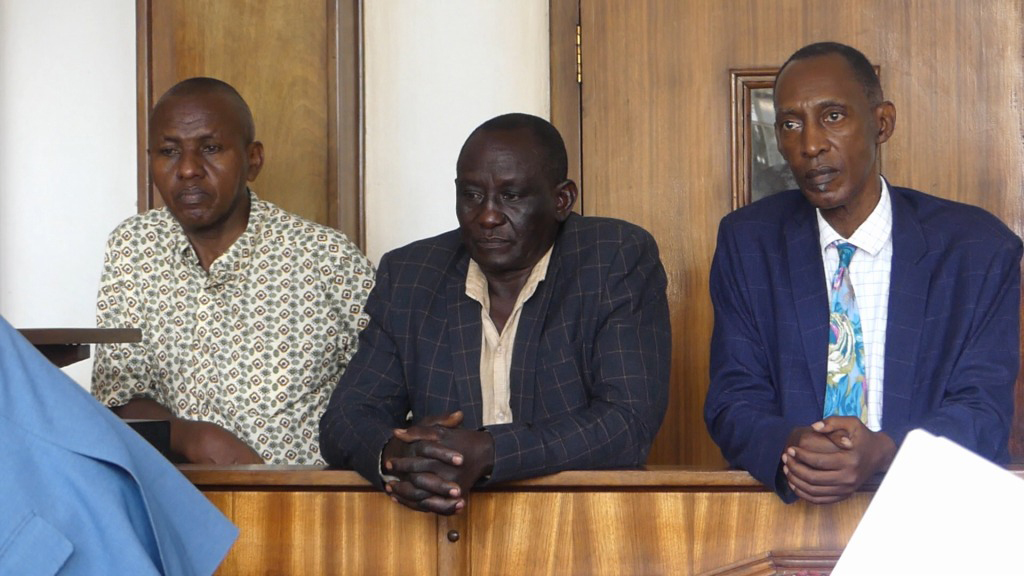

Between December 2012 and June 2014, William Barigye, an employee at the Ministry of Internal Affairs, discovered that money meant for him had been going to another person’s account at PostBank (now Pearl Bank).
Barigye worked as an assistant commissioner in the Legal and Inspectorate Services Department. He maintained his personal bank account at Centenary Bank, where he expected to receive his salary and other work-related payments.
He insisted he had never opened or operated an account with PostBank.
Barigye claimed that another man named “William Baligye” held an account at PostBank and ended up receiving Shs15 million that was intended for him.
The money included salary payments and facilitation for official duties at the Directorate of Citizenship and Immigration Control.
Barigye said that although the names “Barigye” and “Baligye” were not the same, money meant for him continued to be sent to the PostBank account between December 2012 and June 2014.
The problem eventually came to light, prompting the director of Citizenship and Immigration Control to write to PostBank on August 4, 2014, asking it to refund the money.
The bank received the letter the following day but did not recover the funds, leading Barigye to sue for the lost money, damages and interest.
PostBank explained that between 2012 and 2014 it received electronic payment instructions from the Bank of Uganda directing it to credit Account Number 001030017010586 in the name of “Barigye William.”
The bank said it simply followed those instructions, which had originated from Barigye’s employer, through the government payment system.
The bank further argued that Kawempe Police Station wrote to it requesting it to update “009 SPC Barigye William” bank records, which it did.
It said that the account holder used both “Baligye William” and “Barigye William” interchangeably.
PostBank also maintained that for nearly two years neither Barigye nor his employer complained about the missing payments.
The case was taken to the Kawempe Chief Magistrates Court, which agreed with Barigye and found that PostBank became negligent by continuing to release the money after the problem had been brought to its attention.
The magistrate awarded Barigye Shs 30 million in general damages and exemplary damages, with interest at 24% per year from December 2012 until full payment.
PostBank appealed the decision in the High Court, where its lawyers from Arcadia Advocates argued that the trial magistrate had wrongly evaluated the evidence and incorrectly concluded that the bank had acted negligently.
The bank’s lawyers said their client merely acted on electronic payment instructions received from the Bank of Uganda, which had been generated by Barigye’s employer, the Ministry of Internal Affairs.
They said that once those instructions reached the bank, it had a duty to credit the account indicated and could not be held responsible for an error made before the money reached PostBank.
The lawyers also relied on the legal principle that a bank’s duty of care is owed to its own customer, arguing that because William Barigye never held an account with PostBank, no legal relationship existed between him and the bank.
However, Barigye’s lawyers from Semuyaba, Iga & Co. Advocates defended the judgment of the chief magistrate and urged the High Court to uphold it.
They maintained that the bank had been negligent because it continued releasing money to another person even though there was a clear difference between the names “Barigye” and “Baligye.”
His lawyers argued that the payments included Barigye’s salary and official facilitation and that PostBank should have detected the discrepancy and prevented the money from being withdrawn.
They also maintained that once the Director of Citizenship and Immigration Control notified the bank of the error and requested a refund, PostBank ought to have taken action.
Justice Simon Peter Kinobe, who handled the case, started by explaining that although the relationship between a bank and its customer is based on trust and contractual obligations, a bank cannot be held responsible for every payment error.
“The bank client relationship is a delicate equilibrium of rights and obligations,” Justice Kinobe said, adding that both banks and customers have responsibilities in ensuring financial transactions are handled correctly.
He accepted PostBank’s argument that William Barigye had never been its customer and also agreed with the bank that there was nothing suspicious about the transactions when they were made because the account holder presented identification in the name “Barigye William” and signed withdrawal slips using the same name.
Justice Kinobe discovered that the bank only learned of the mistake after all the money had already been withdrawn.
“The fact that the anomaly of the above transactions was raised way long in August 2014 after the said monies had already been withdrawn shows that the bank would not have reasonably foreseen that the transactions were irregular,” he said.
Justice Kinobe concluded that because PostBank owed no duty of care to Barigye, the negligence claim could not succeed.
“This means that the bank did not owe Barigye any duty of care. This automatically lapses the other two ingredients of breach of that duty and any resultant damage,” he ruled.
Justice Kinobe therefore said the magistrate, who had ruled in Barigye’s favour, had reached the wrong conclusion and overturned the earlier award of Shs 30 million.
However, he directed that each side bear its own legal costs of the appeal.