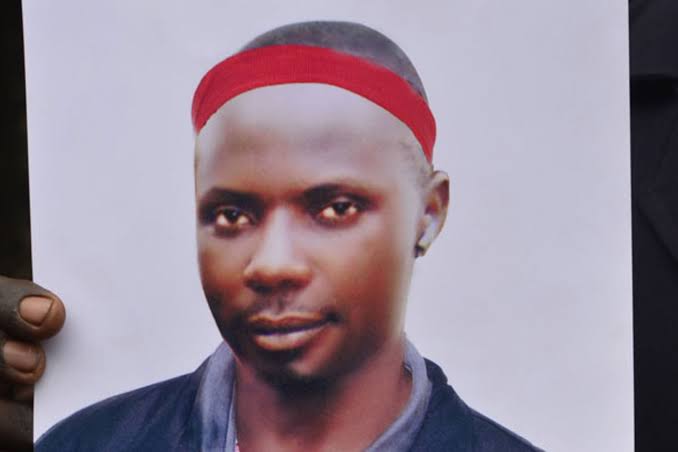
Eight years after the shooting that killed Yasin Kawuma, the driver of Robert Kyagulanyi, aka Bobi Wine, the High Court has ordered a judicial inquiry into the circumstances of his death.
Kawuma was shot dead on August 13, 2018, during the tense Arua Municipality parliamentary by-election campaigns. He was shot at about 6.40 pm in Arua Municipality by soldiers attached to the Special Forces Command (SFC).
A medical report later confirmed that he died from a brain injury caused by gunshot wounds.
In a landmark ruling, Justice Harriet Grace Magala said Kawuma’s violent death raises important questions that can only be answered through an official inquest.
The legal victory came after Kawuma’s widow, Alice Mwesigwa, successfully challenged the government’s opposition to her application, arguing that her husband deserved justice and that his family and the public had a right to know what happened.
Mwesigwa went to court seeking an order requiring the then Minister of Internal Affairs, Jeje Odong, to appoint a coroner to investigate the circumstances under which her husband was killed.
Through her lawyers, Mwesigwa argued that Kawuma’s death was violent and suspicious and therefore deserved an official inquiry under the Inquests Act.
Her lawyers told the court that since Kawuma did not die naturally or as a result of a lawful court sentence, an inquest was necessary.
The government opposed the application, saying the High Court could not order the minister to appoint a medical examiner because that was an executive function given to the minister by law.
It said Mwesigwa had never first asked the minister to act before filing the case in court.
The government further argued that she should have first gone before a magistrate in Arua or another person already serving as a coroner, rather than rushing to the High Court.
The government also questioned Mwesigwa’s affidavit, saying she was in Lusanja in Wakiso when the shooting happened in Arua and therefore did not personally witness the incident.
Nakasero Hospital fired a nurse after her daughter fell ill. Court has awarded her Shs 1.6 million
Justice Magala dismissed the government’s arguments, noting that the medical certificate attached to Mwesigwa’s affidavit clearly showed that Kawuma died from gunshot wounds and that the government had not disputed that fact.
She said an inquest is a judicial inquiry carried out to establish important facts about a person’s death, especially where the death is violent, suspicious, or unexplained.
“The purpose of the investigation into a person’s death is to ascertain who the deceased was and how, when, and where the deceased came by their death… to seek out and record as many of the facts concerning the death as the public interest requires,” she said.
Justice Magala said there was no dispute that Kawuma’s death was unnatural because he succumbed to a gunshot wound.
She said the Constitution protects every person’s right to life and that when someone dies violently without a clear explanation, there must be an inquiry.
“Thus, when one’s right to life is taken away in circumstances where the death is not due to natural causes, and there is no clear explanation of how the incident that led to the death occurred, there is a need for an investigation or inquiry into the circumstances leading to the death,” Justice Magala said.
She stressed that an inquest is not a criminal trial but assists in finding answers to the circumstances surrounding the death of the person whose life was suspected to have been unjustly taken away.
While agreeing with the government’s argument that the court could not compel Jeje Odongo to appoint a medical examiner, Justice Magala argued that the court has the power to order an inquiry.
Since magistrates are recognised as coroners under the Inquests Act, she directed the Chief Magistrate of Arua Chief Magistrate’s Court to conduct the inquiry.
Unless the government appeals, Justice Magala’s ruling means that authorities have now been directed to investigate the circumstances under which Kawuma died.