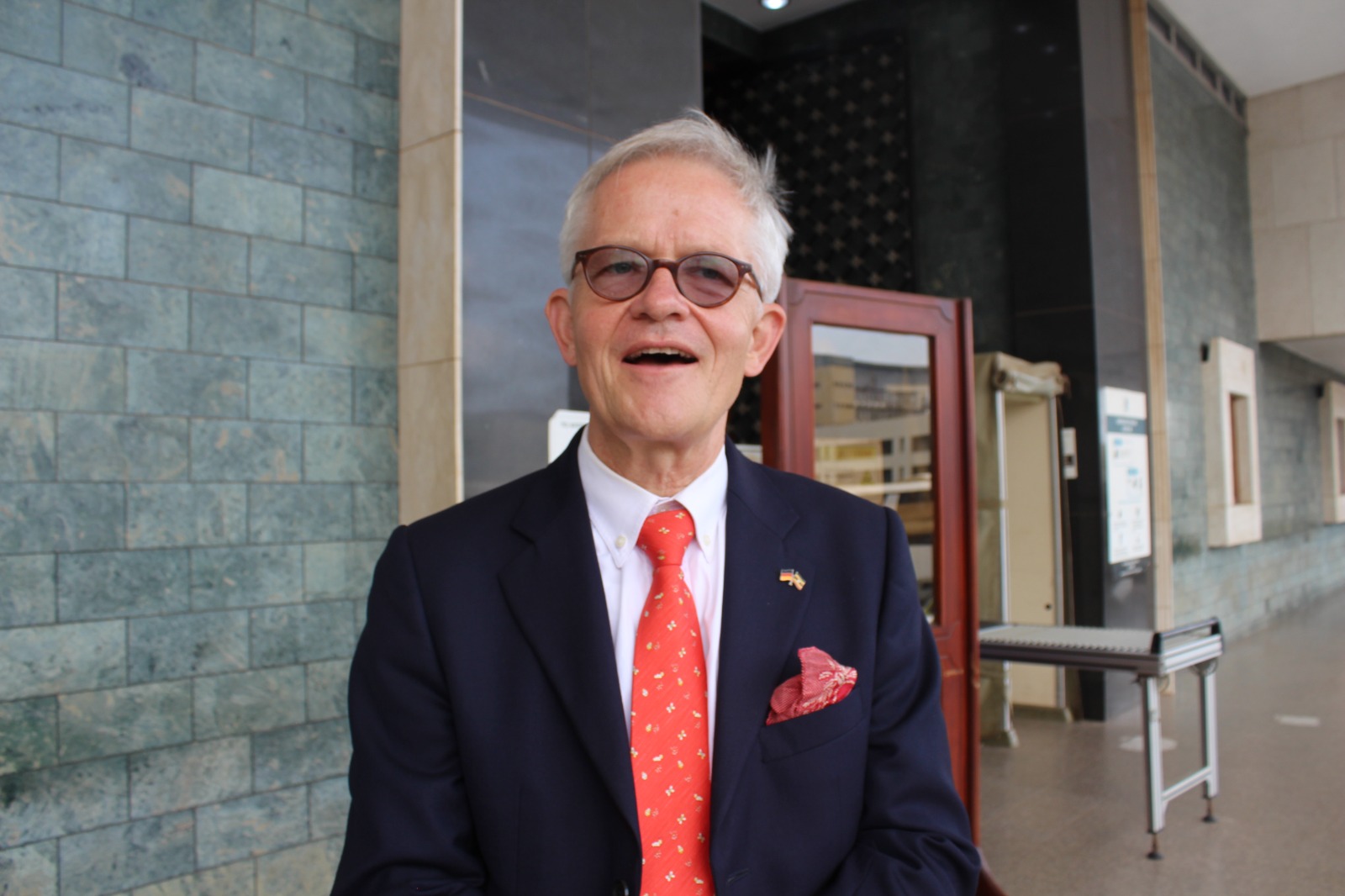
The outgoing German Ambassador to Uganda, Mathias Schauer, has urged legislators to focus their legislative work on improving service delivery for ordinary Ugandans.
Schauer made the remarks while speaking to journalists after paying a farewell visit to Deputy Speaker Thomas Tayebwa at Parliament.
He said the lawmakers should prioritise sectors that directly affect people’s lives, including education, healthcare and infrastructure development.
“As development partners of Uganda, we encourage Members of Parliament to focus on education, health and infrastructure so that the wellbeing of the people can be improved,” Schauer said.
The ambassador, who took office on July 25, 2020, is set to leave Uganda for another diplomatic assignment, which has not yet been announced.
He said Germany remains committed to supporting Uganda’s development agenda through various partnerships and programmes.
According to Schauer, Germany will continue supporting key government priorities, including education, healthcare, environmental protection, road maintenance, energy development and good governance.
He also expressed concern about reports of human rights violations involving opposition politicians and members of the media.
Schauer said such incidents continue to undermine Uganda’s progress towards strengthening democratic governance.
On international affairs, the ambassador reiterated Germany’s support for Ukraine in its ongoing war with Russia.
He said Germany, together with its NATO allies, remains committed to supporting the Ukrainian people against what he described as aggression from Moscow.
Although Germany has not deployed troops directly to the battlefield, Schauer noted that his country has provided military, humanitarian and financial assistance to Ukraine.
Reflecting on his time in Uganda, the envoy praised the country’s hospitality, saying visitors are often made to feel at home.
He said he would miss Uganda’s rich tourism attractions, wildlife and diverse cuisine.
Germany has been one of Uganda’s long-standing development partners since the country gained independence in 1962.
Through the Germany’s ministry for Economic Cooperation and Development (BMZ) and the German Agency for International Cooperation (GIZ), Germany has supported numerous projects in Uganda, particularly in the areas of energy, agriculture, environmental conservation and good governance.