Justice Stephen Mubiru has ordered the estate of the late Prof George Wilson Kanyeihamba to pay Shs 45 million to Yusuf Kiwanda, a writer who said the retired judge used his work on a law textbook without paying or crediting him.
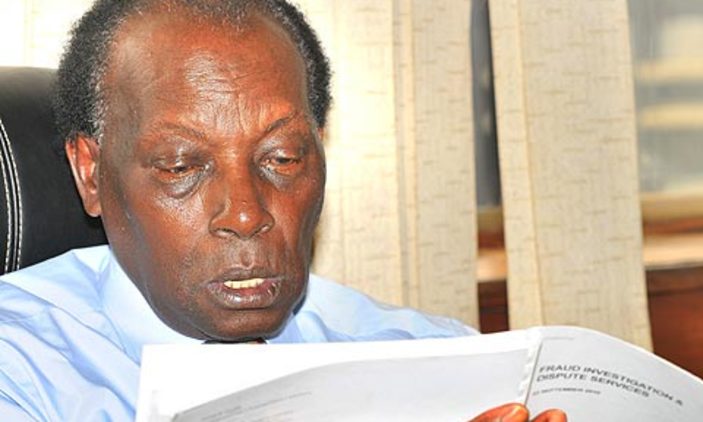
Kanyeihamba died in July last year, long before the ruling. He was a prominent lawyer and scholar who served as a Supreme Court Justice.
In 1975, he published a book titled Constitutional Law and Government in Uganda, which has become a reference point for many students undertaking the law course at degree level in Uganda.
By the 2010s, the book was almost 50 years old, and Kiwanda said Kanyeihamba asked him to update it to fit modern Uganda.
The agreement between the two was not written, but Kiwanda says Kanyeihamba agreed to include him as a co-author and to receive 30% of the money from sales. The title of the revised book was to be: Kanyeihamba’s Constitutional Law, Public Law and Government.
Kiwanda said he researched, added case law and laws passed since 1975, and wrote new chapters, including one on corruption. The old book had 14 chapters. The new manuscript had 21.
Kiwanda was recommended to Kanyeihamba by Macharia Muriuki of Panamaline Books. The two men met at Kanyeihamba’s home in Buziga, where Kiwanda was “tasked to come up with new and updated chapters”.
However, the relationship later collapsed partly because Kanyeihamba wanted Kiwanda to sit with him and proofread every chapter, but Kiwanda could not because he had already taken his leave.
Angry at his stance, Kanyeihamba told him, “never to come to him or call him regarding the book”.
Kiwanda told the court Kanyeihamba later offered him Shs 1 million for his services. He refused the money and wrote to the professor and the publisher, warning them not to publish his chapters.
Kanyeihamba ended his deal with Panamaline and found another publisher.
Around March or April 2021, Kiwanda saw an advert for the launch of a book titled Evolution of Constitutional Law, Public Law and Government. He bought a copy.
He told the court it was “identical to the manuscript he had shared” with the professor and the publisher. His name was gone, and the title and preface had been changed.
Kiwanda sued Kanyeihamba, who neither filed a defence nor came to court.
Ecobank Uganda claimed a construction firm owed it Shs 1bn but couldn’t prove the debt in court
In his ruling, Justice Mubiru did not accept everything Kiwanda said. For instance, he said he ought to have put the agreement in writing because that’s what the Copyright Act demands.
So Kiwanda, the judge said, could not claim co-authorship through that agreement.
However, he said he agreed that Kiwanda was the author of the revised work anyway.
“[Kiwanda] is the author because he created the work…Kanyeihamba did not write any of the 7 new chapters,” he ruled.
Justice Mubiru said what Kanyeihamba did was “a blatant, unauthorised commercial exploitation of Kiwanda’s copyright”.
He said removing Kiwanda’s name and publishing under sole authorship was “a textbook case of such repudiation”.
On the Shs 1 million offer that Kanyeihamba had offered Kiwanda, Justice Mubiru said it was “insultingly low.”
In the end, he ordered that Kiwanda be given Shs30 million in general damages and Shs15 million in exemplary damages, meant to punish wrongdoing. That is Shs45 million with interest at 6% per annum from the day of judgment until payment.
He said Kanyeihamba acted with “cynical disregard” of Kiwanda’s rights, noting that the professor held “a massive imbalance of professional stature” over a junior colleague.
Justice Mubiru also ordered Kanyeihamba’s estate to account for the money from sales of the book, with Kiwanda getting 30% of the gross. He said the unsold copies are to be seized, while Kiwanda will have to be acknowledged as co-author.
He ruled that Kiwanda’s payment will come only from the property of the deceased that has come into the hands of someone who will be chosen as his representative.
Kiwanda was represented by EJ Sendegeya & Associates Advocates. No one appeared for Kanyeihamba.