More than Shs1.5 billion in legal fees claimed from the estate of the late Muhamad Katimbo, who was a prominent businessman in Kikuubo, has been thrown back into dispute after the High Court blocked recovery of some of the fees and ordered the rest to be examined afresh.
The ruling followed a fight involving lawyer James Kiiza and Ihsan Advocates over whether Katimbo had already paid for legal services before his death. At the time of his death in 2023, Katimbo was the chairman of Kikuubo Traders Association.
The disagreement began with several court cases in which Kiiza represented Katimbo while working under the name of Mugisa, Namutale & Co. Advocates (which later became Ihsan Advocates).
Kiiza was the lawyer who appeared in court, prepared documents, and dealt directly with Katimbo.
When Katimbo died, his estate changed lawyers, and that is when the dispute over the legal fees became serious.
Ihsan Advocates presented a number of bills to Katimbo’s estate, asking to be paid for the legal work done in the different cases. The legal fees amounted to Shs 1.5 billion.
Not satisfied, Katimbo’s estate administrators challenged the amount and eventually succeeded in having the earlier decision cancelled after the court ordered that the bills be looked at again by another court officer.
Before that fresh process was completed, Kiiza went back to court with his own complaint.
His argument was that Katimbo had personally instructed him and had already paid him for the legal work.
He also argued that some of the legal work could not legally attract fees because he had done it before obtaining his practising certificate for 2020.
Kiiza told the court that his practising certificate was issued on June 25, 2020, meaning that the work was done before his practising certificate was issued.
Kiiza therefore wanted the court to stop the fresh examination of the bills altogether and declare that Katimbo had fully paid his legal fees and other expenses.
He also wanted the court to declare the earlier bills no longer relevant and to permanently stop the fresh examination ordered by the court.
But Ihsan Advocates said Katimbo had hired the law firm, not Kiiza personally.
According to the firm, Kiiza was working as its employee or as a lawyer assigned to handle Katimbo’s cases.
The firm argued that Kiiza’s current story was different from what he had previously told the court.
The administrators of Katimbo’s estate, however, supported Kiiza on the issue of payment.
They said Katimbo had paid for the legal services while he was still alive and their concern was that the estate could end up paying twice for the same work.
The administrators also argued that the law does not allow lawyers to recover fees for certain work done before they had a valid practising certificate.
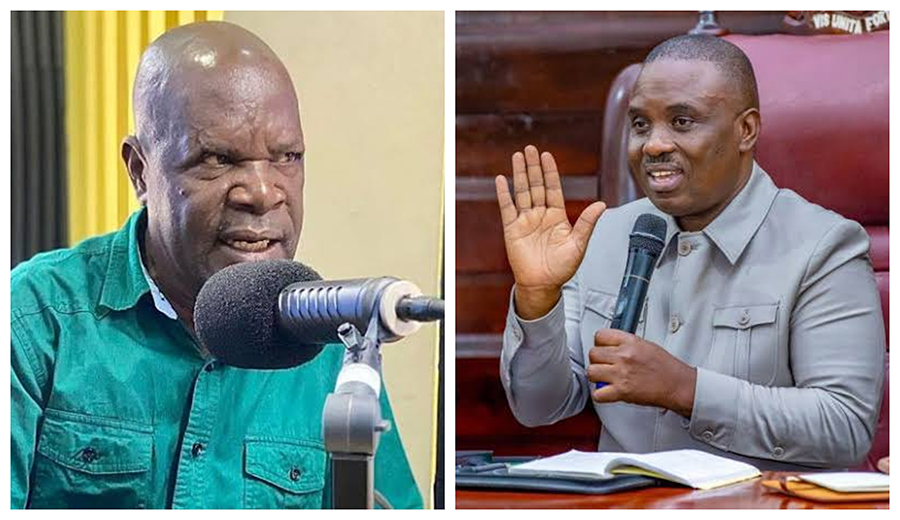
Opondo only ‘punched’ Lukwago in a ‘movie’ not NBS TV studio, court rules
Before issuing a ruling, Justice Rosemary N. Bareebe first considered whether Kiiza had a right to bring the case and found that he had a genuine interest in the dispute because he was the person who had actually done much of the work for which Ihsan Advocates was demanding money.
She said Kiiza also had a professional responsibility to tell the court about payments and any problem with the legal work.
But Justice Bareebe said all this notwithstanding, it did not mean Kiiza could simply cancel the law firm’s bills.
She then examined whether Katimbo had hired Kiiza personally or had hired the law firm because he had argued that Katimbo personally instructed him and that his relationship with the law firm was only “of counsel”.
He also described the law firm as little more than an address through which his practising certificate was processed.
Justice Bareebe did not accept Kiiza’s explanation, saying that the court documents had been filed in the name of Mugisa, Namutale & Co. Advocates.
She also found Kiiza’s earlier statements troubling and contradictory because he had told the court that Katimbo instructed the firm, which then assigned the cases to him.
Therefore, his new claim that he had personally been hired by Katimbo and fully paid was difficult to reconcile with his earlier statements.
“Those contradictions are fundamental,” Justice Bareebe said.
However, she also ruled that Ihsan Advocates could not use Kiiza’s work to demand money from the estate and then distance itself from payments he may have received while acting for the firm.
The firm had itself argued that Kiiza was its employee or an advocate assigned to Katimbo’s cases.
She said the firm had allowed Kiiza to work under its name, use its address, handle Katimbo’s files, sign court documents, appear in court and deal directly with the deceased.
This became important when the court considered the money Katimbo was said to have paid.
Justice Bareebe ruled that if Kiiza received money from Katimbo while acting within the authority given to him by the firm, that payment had to be treated as a payment to Ihsan Advocates.
But she did not accept that all the payments listed by Katimbo’s administrators had been made to Kiiza.
The administrators had produced an inventory of payments made for legal services.
However, the inventory did not clearly separate money paid to Kiiza from money paid to another lawyer, Harouna Kagodo Kinsambwe.
She therefore said every payment Kiiza had specifically acknowledged and which could be linked to the cases in question must be deducted from the relevant bill.
At the same time, Justice Bareebe said Kiiza had failed to prove that every amount in the inventory had been paid to him or that all the legal bills had already been settled.
This meant that the estate could not simply walk away from the entire Shs1.5 billion claim.
She finally looked into the claim that Kiiza was working as an advocate before receiving his practising certificate because he had admitted doing specific work on June 18, 2020, while his certificate was only issued on June 25.
Justice Bareebe said the law was clear that fees could not be recovered for professional work done in circumstances prohibited by the Advocates Act and ordered that every item relating to work Kiiza performed before June 25, 2020, be removed from the bill.
She also rejected Kiiza’s attempt to permanently stop the fresh examination of the bills, saying the earlier order directing the fresh process remained valid because Kiiza had not asked the court to formally review or overturn it.
“The fresh taxation is the proper forum” for determining what, if anything, is still owed, Justice Bareebe said.
She said the court will therefore not decide the final amount at this stage when a designated court officer will go through the bills again.
Justice Bareebe directed that evidence of payment should not be rejected simply because money was paid in cash, saying the court officer must consider Kiiza’s own admissions, the payment inventory, oral evidence, mobile-money records and other accounts.
“No payment shall be rejected solely because it was made in cash or without a formal receipt,” she ordered.
In the end, Kiiza got only a partial victory.
While he failed to convince the court that Katimbo had personally hired him and fully paid all the disputed fees, he succeeded in getting the court to rule that payments he received and acknowledged must be credited to the law firm’s bills.
Kiiza also succeeded on the issue of work done before his practising certificate was issued because Justice Bareebe ruled that fees for that work cannot be recovered.