The signs were there from the very beginning, but somehow, Hope Kyomugisha hoped her husband, Friday Mugisha, would change into a better person.
On their wedding night in 1992, Mugisha allegedly slapped her after an argument. Kyomugisha, fearful of disappointing many people, including her parents, chose to stay.
Little did she know that the beating that night would set the tone for years of abuse, fear, and eventual exile from her own home.
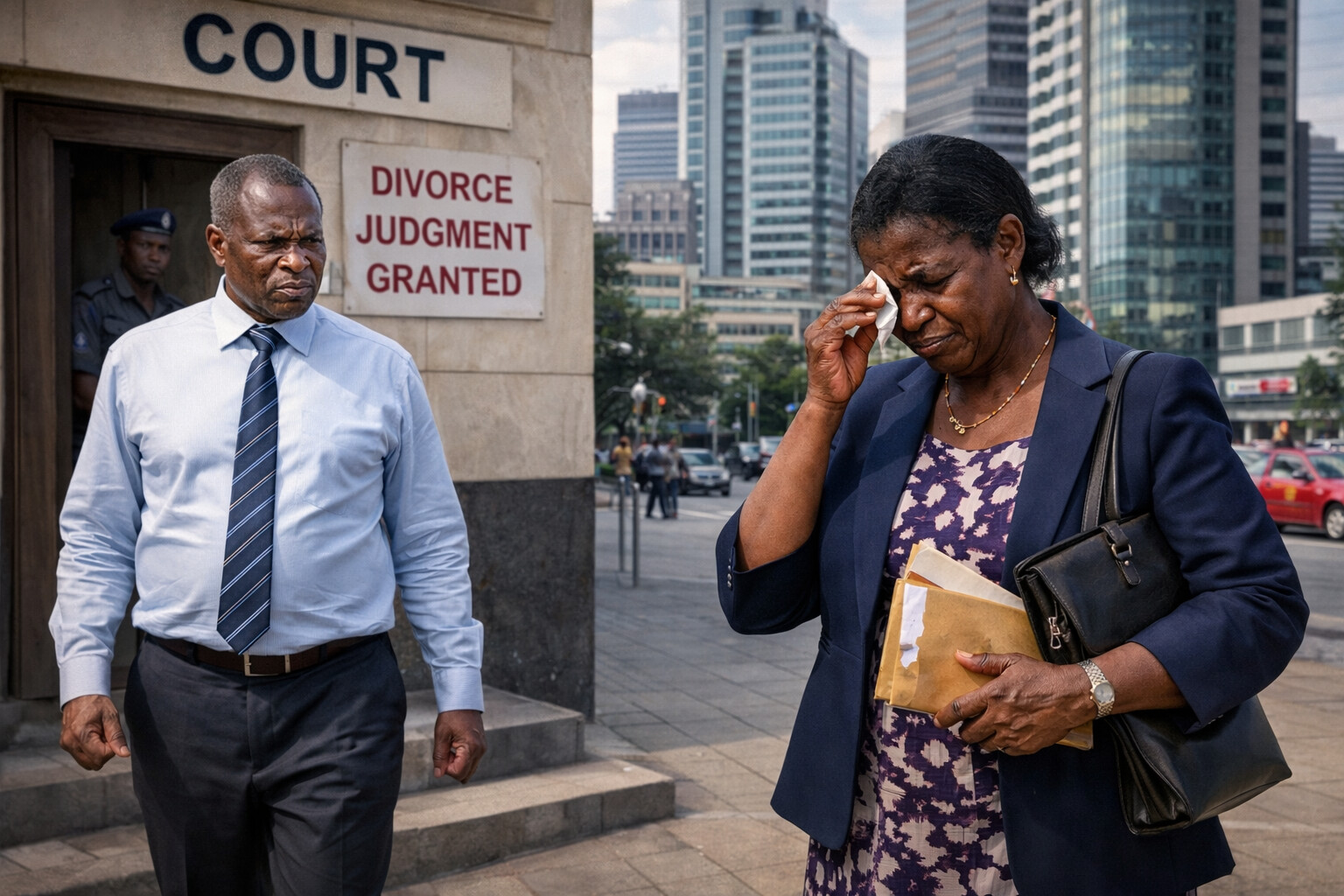
This week, Justice Celia Nagawa decided to release Kyomugisha from her misery after she dissolved the 33-year-old union, bringing to a close a bitter domestic battle marked by violence, property fights, and years of separation.
The two were married on May 2, 1992, at St James Cathedral in Ruharo, Mbarara. They had four children, now all adults. For 17 years, they lived together, mainly in Bugolobi, Kampala, before Kyomugisha was driven out of the matrimonial home in 2009.
In her petition, Kyomugisha painted a grim picture of life behind closed doors. She told the court that soon after the wedding, Mugisha became violent, abusive, and habitually drunk. He would disappear from home and return in the early hours, she said, often angry and aggressive.
The violence, according to Kyomugisha, escalated in the early 2000s. In May 2005, she said, Mugisha pushed her out of a moving vehicle in Gabiro, threw her into a roadside trench, and kicked her repeatedly.
The assault ruptured her right kidney and left her permanently weakened.
She told the court she underwent several surgeries at Kibuli hospital in Nairobi and later in India.
Kyomugisha also recounted public humiliation. In January 2010, she said, Mugisha beat her at a party in full view of guests.
Months earlier, in November 2009, she said he threatened to kill her, chased her out of their Bugolobi home in the middle of the night, and called her father to come and collect her.
Mugisha denied all allegations. He told the court he was a loving husband and claimed Kyomugisha deserted the marriage voluntarily. He denied beating her, denied adultery, and said his Christian faith did not allow divorce.
“She is free to continue living with me,” he argued.
How a South African firm tried to block Uganda’s “Aquelle” mineral water brand
Justice Nagawa was not persuaded.
She noted that Kyomugisha’s allegations were detailed, consistent, and stretched over many years, with specific places and dates.
She also observed that Kyomugisha had filed an earlier divorce petition in 2012, which was abandoned only because she was flown to India for medical treatment.
“The petitioner’s account presents a consistent narrative of violence, humiliation, and eventual expulsion from the matrimonial home. The respondent’s defence consists largely of bare denials without a coherent alternative explanation.”
The court found that Kyomugisha had lived separately from Mugisha for about 14 years without maintenance, yet Mugisha controlled several properties acquired during the marriage. Justice Nagawa said that it would be unreasonable to expect Kyomugisha to return to such a marriage.
The court concluded that the marriage had irretrievably broken down, leaving no room for reconciliation.
Properties
During their marriage, the couple acquired multiple properties, including houses in Bugolobi, Kirombe, Luzira, Mbuya, and Kitintale, commercial property in Kajjansi, land in Kinawataka, and a large farm in Kiruhura district.
Kyomugisha told the court that the properties were acquired through joint effort. She ran a restaurant business known as Family Bucket, while Mugisha worked as an accountant, a job she said he got through her uncle, Brig Mugenyi.
Mugisha admitted under cross-examination that all the properties were acquired after the marriage.
“No property was bought before 1992,” he testified.
Justice Nagawa ruled that Kyomugisha would retain the house in Kirombe, Luzira where she has lived with the children, and the commercial and residential house in Kitintale Zone, Luzira.
Mugisha was awarded the residential house in Mbuya and retained the Bugolobi flat where he currently lives. The large farm in Kazo was left undistributed after Mugisha claimed it was family land he shared with his siblings.
Each party was ordered to bear their own legal costs.