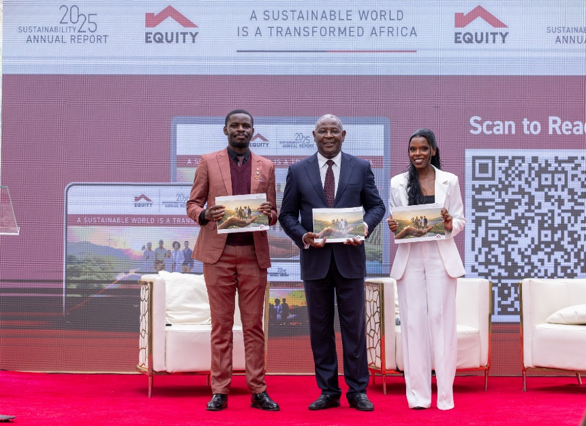
Equity Group Holdings invested a record $771m (Shs 3.1 trillion) in social impact and sustainability programmes across its markets in 2025, according to its latest sustainability report.
The report was unveiled in Nairobi this week under the theme ‘A Sustainable World is a Transformed Africa’.
The report covers enterprise development, education, health, financial inclusion, climate action and responsible business.
It says the group builds sustainability into its strategy, governance and risk management through its Tri-Engine Model, which combines economic performance, social impact and sustainability.
Dr James Mwangi, the group’s managing director and chief executive, said the results showed that profit and development do not pull in opposite directions.
“Our 2025 performance demonstrates that commercial success and sustainable development are not competing priorities, but mutually reinforcing drivers of long-term prosperity,” he said.
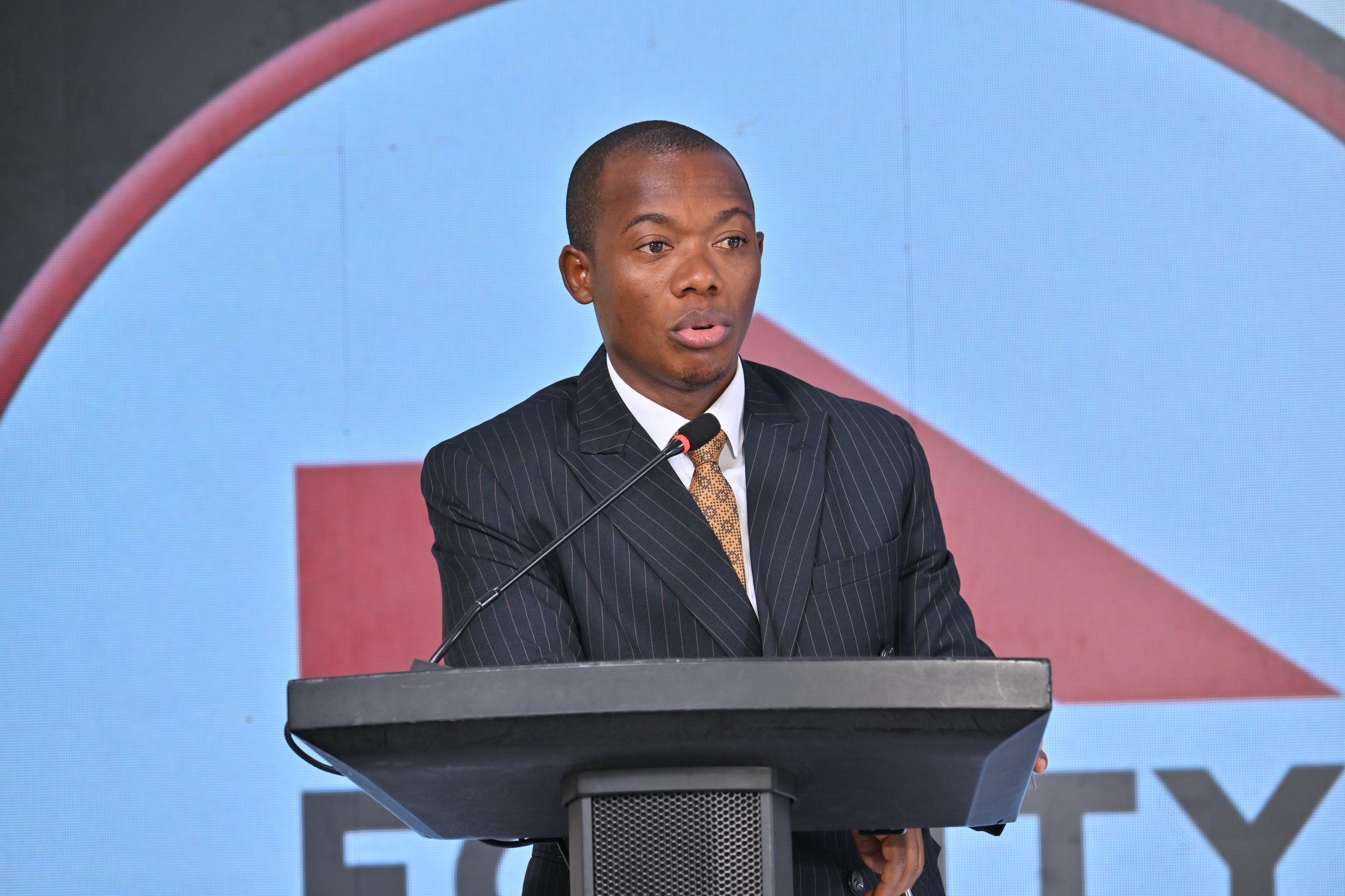
Gift Shoko, managing director and chief executive of Equity Bank Uganda, said the agenda mattered most when it answered local needs.
“In Uganda, our ambition is to ensure that banking contributes to lasting economic and social progress,” he said. He added that this meant helping businesses grow and widening access to suitable financial products.
Social protection programmes reached 5.94 million people in 2025, backed by $1.34bn (KSh173.5bn) in cash transfers. The group also lent $450,000 (KSh57.9m) to 115 refugees and trained a further 772.
Equity disbursed about $3.1bn (KSh404bn) to micro, small and medium-sized enterprises (MSMEs). Local suppliers received 90% of its procurement spending, worth $369m.
Through the Equity Group Foundation, the group has trained 962,924 MSMEs in entrepreneurship. It has also given financial education to 2,490,471 women and young people.
In farming, it reached 622,525 small and medium-sized farmers with climate-smart finance, training and links to value chains.
The report records 60,009 scholarships, including 29,515 for university students, 4,039 for technical and vocational training and 1,115 for global scholars. The group also arranged 9,772 paid internships.
The foundation works with IamtheCODE Foundation, Huawei ICT Academy, WorldQuant University, Amazon Web Services and Moringa School on digital skills. Under the Equity Leaders Programme, 415 innovators found jobs after a 12-month tech apprenticeship.
In health, Equity Afya, the group’s medical franchise, has grown to 150 outpatient centres in Kenya and the Democratic Republic of the Congo. It has recorded more than 4.62 million patient visits since it began.
On climate, the group deployed more than $201m (KSh26bn) in sustainable and climate-aligned finance. It recorded more than 47,000 climate-related transactions under the IFC Climate Adaptation Finance Initiative.
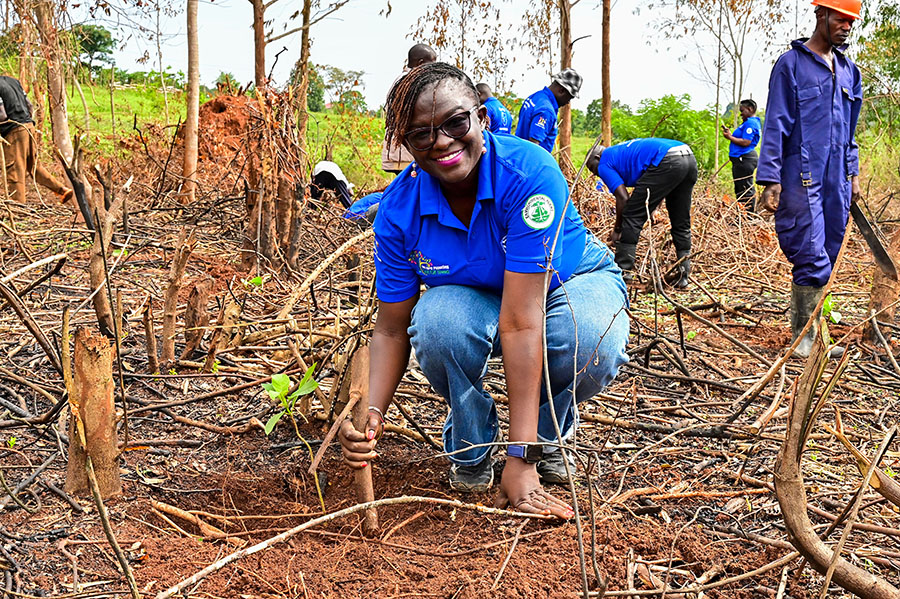
It also distributed 75,855 clean-energy products and planted 9.1 million trees. That lifts its total to 44.6 million, above its target of 35 million.
The group says it screens lending for environmental and social risk, carries out extra checks on high-risk sectors and runs climate stress tests. It is also preparing to adopt the IFRS S1 and S2 sustainability disclosure standards.
Staff numbers rose to 13,370. Average training per employee reached 74 hours, up from 45 in 2024, while staff turnover fell to 10.6% from 11.1%.
Sebastian Groth, the German ambassador to Kenya, said governments, businesses and development institutions must work together. He said public funds should be used to mobilise private capital.
“We provide the spark, but the private sector provides the scale and keeps the fire burning,” he said.
Nasra Nanda also praised the group at the launch. She said banks could help make sustainable construction accessible to ordinary borrowers.
“A home is only truly affordable if a family can afford to live in it over time,” she said.
Equity Bank (Kenya) Limited, which earns most of the group’s revenue, also published a Sustainable Development Impact Disclosure. It sets seven impact goals tied to the UN Sustainable Development Goals and commits the bank to report yearly on both positive and negative effects.
By 2030, the bank wants 30% of its loans to go to food and agriculture, 65% to MSMEs and 15% to manufacturing. It also plans to double Equity Afya to 300 clinics.
In 2025, MSMEs made up 56.6% of its loan book, up from 50.1% in 2023. Lending to women rose to 23.9% from 18%.
The strategy covers banking, insurance, technology and foundation operations in Kenya, Uganda, Tanzania, Rwanda, South Sudan and the Democratic Republic of the Congo. The group also has a representative office in Ethiopia.