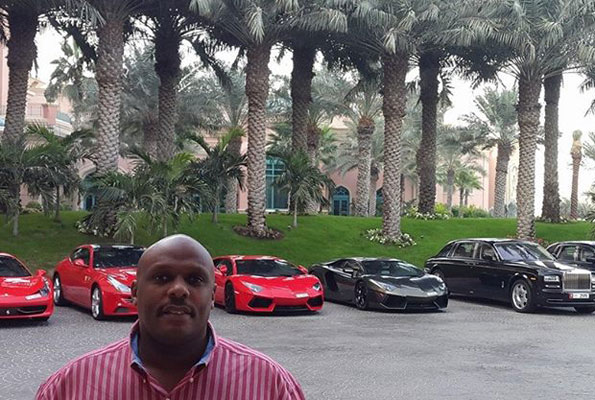
Once upon a time, in Naguru, Kampala, Andrew “Desh” Kananura, a renowned businessman and Vehicle and Equipment Leasing, a car leasing firm, entered into a deal.
On the surface, the deal sounded simple.
Vehicle and Equipment Leasing needed space to park many cars that it had imported. Kananura had the space at Panamera Bar, which he owns, opposite Kampala Parents School.
So in April 2019, the two parties met and agreed that Vehicle and Equipment Leasing would park its vehicles at Panamera and that it could conduct vehicle sales in the bar’s parking. They also agreed on the parking fees and security arrangements for the vehicles.
Here are the details. For each day that Vehicle and Equipment Leasing held a car sale, Kananura charged them Shs 2.5 million. The company was also supposed to pay Shs 3,700 per vehicle per day for parking.
As they say, Kananura and the firm shook hands and moved on.
At first, things looked fine. Car sales were held on April 12 and 13, 2019.
However, the problem is that Vehicle and Equipment Leasing kept bringing in more cars into the parking, yet the sales were low.
So Kananura, who has a good taste for fine cars, came up with a good solution, or he thought. He started buying some of them. This is where the trouble really began.
Between 2020 and late 2020, Kananura took five vehicles from the parking lot. A Toyota Hilux, a Nissan Hard Body pickup, two Toyota Land Cruisers, and a Volkswagen Amarok. Some of these sales were documented, but others were based on talk and trust between the two parties. Other times, Kananura made promises to pay, but he did not fulfil them.
After several meetings trying to amicably resolve the matter, Vehicle and Equipment Leasing went to court. The company said Kananura had taken five vehicles but failed to pay for most of them. It said the total unpaid amount was Shs 255 million.
Kananura strongly disagreed. He said he did not owe the company anything. In fact, he said the company owed him more money. According to him, the company had parked as many as 130 vehicles at his parking yard for many months without paying full parking fees.
By his calculation, he said the company owed him Shs 284.3 million. So the court had to resolve two big questions: Who owed whom? And how much?
Justice Stephen Mubiru, of the Commercial Division of the High Court, heard the case. He started with the issue of the five vehicles Kananura had taken, some on credit. Three of them, it was discovered, had been fully paid by Kananura.
The fight was about the other two vehicles: the Land Cruiser registration UAZ 468 E and the Volkswagen Amarok registration UAW 554 F.
At first, Kananura told the court he never bought these two cars at all. Later, under cross-examination, he admitted that he did. Justice Mubiru was not pleased with this change to the story. He said when a witness says one thing and later says the opposite on an important issue, the court is likely to see that witness as unreliable.
He also noted something else. Even where prices were not clearly agreed in writing, Kananura took the vehicles and used them. In simple terms, he told Kananura, “You cannot take someone’s car, enjoy it, and then argue that there was no deal.”
Justice Mubiru explained that when someone receives a benefit, like a car, and keeps it without paying, the court can create what is called a quasi contract. That means the person, like Kananura, must pay a fair price, even if the paperwork was weak.
To decide that fair price, the court looked at professional valuations done at the time. These showed the Land Cruiser was worth Shs125 million and the Amarok Shs 65 million. Kananura did not bring any valuation to challenge these figures.
When the prices of all five vehicles were added up, and the payments Kananura had already made were subtracted, Justice Mubiru found that he owed Vehicle and Equipment Leasing Shs 255 million.
Then the court turned to the parking fees, and here, things became messy.
Both sides accused each other of hiding records showing how many cars were parked and for how long. Justice Mubiru noted that the main record book was kept at the yard but managed by the company’s agent. He also noted that Vehicle and Equipment Leasing removed its vehicles quietly, at night, without warning.
Because of this, the judge believed the company was more likely to have taken the true records with it. The law allows a court to draw a negative conclusion against a party that hides or destroys important evidence.
Using estimates and the parts of the claim that were not disputed, the court accepted that some parking fees were owed. These included fees for car sales, vehicle parking, and earth-moving equipment.
After subtracting the payments the company had already made, Justice Mubiru found that Vehicle and Equipment Leasing owed Kananura Shs 114 million in parking fees.
Finally, the judge put the two debts together and set one off against the other. When that was done, Kananura was still in debt.
Justice Mubiru ruled in favour of Vehicle and Equipment Leasing and ordered Kananura to pay Shs 140.8 million to Vehicle and Equipment Leasing.
On top of that, the court awarded interest at 20% per year from October 14, 2020, until full payment. Kananura was also ordered to pay the costs of the case. That, in a nutshell, is what happened.