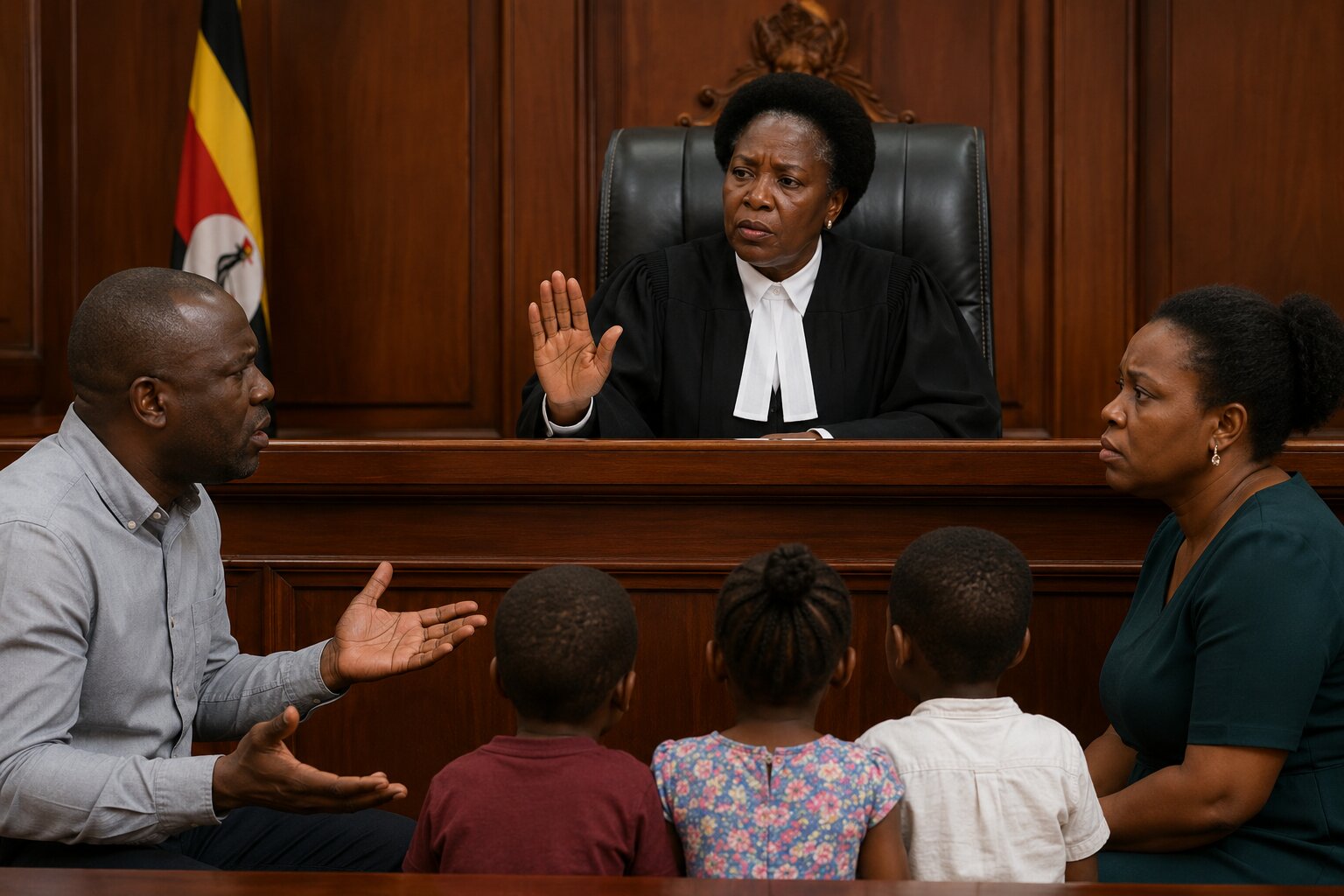
Justice Celia Nagawa of the Family Division of the High Court has rejected an attempt by a man to challenge the paternity of three children that he has raised for years, saying his request came too late and was based largely on untested allegations.
Her ruling arose from a bitter family dispute between Steven Mutyaba and Majorine Nakiyimba, who are already locked in a divorce case.
At the centre of the latest fight was Mutyaba’s request to formally dispute whether he is the biological father of three children identified as Junior Raphael Mutyaba, 15, Nathan Mukiibi, 13, and Lucas Magala, 10.
Mutyaba also wanted the court to order DNA tests to establish the children’s biological father.
The dispute has its roots in the ongoing divorce proceedings filed by Nakiyimba.
Nakiyimba went to court seeking to dissolve their marriage, obtain maintenance, custody of the children, and share property acquired during the union.
Mutyaba responded by denying that there was a valid marriage and also challenged claims relating to maintenance and property.
The issue of the paternity of the three children was never part of Mutyaba’s original defence.
The court heard that Mutyaba already knew that Nakiyimba had given birth to a fourth child fathered by another man while he was living in the United States, and this fact had been included in Mutyaba’s defence.
At this point, he did not question whether the three older children were his.
Mutyaba later claimed that his doubts only emerged during preparations for the divorce case hearing.
According to his evidence, their former housemaid, Esther Nakalyango, allegedly told him that Nakiyimba had been involved in sexual relationships with other men as far back as 2014 and that some of these encounters allegedly happened in the family home.
Mutyaba argued that this information made him question whether he was the biological father of the three children.
Nakiyimba denied being unfaithful before the birth of the three children and maintained that Mutyaba was their biological father.
She presented birth certificates showing Mutyaba as the registered father of all three children.
She also told court that from the birth of the first child in 2010 until Mutyaba left for the United States in 2018, he had never questioned their paternity.
Before considering the main application, the court dealt with several objections raised by Nakiyimba.
One of the objections concerned an affidavit filed by Mutyaba in support of his application.
Nakiyimba argued that the affidavit contained inconsistencies about where and when it was sworn.
Founder of Biyinzika Poultry ordered to refund Shs 130m to foreign investors over botched land deal
Justice Nagawa agreed that there was an error regarding the place where the affidavit was sworn but ruled that the mistake was merely a procedural irregularity and not serious enough to defeat the application.
She then examined whether Mutyaba should be allowed to amend his defence and introduce the paternity issue.
She said courts generally have wide powers to allow amendments to pleadings when necessary, but the circumstances in this case did not justify such a move.
Justice Nagawa observed that Nakiyimba had already completed her evidence in October 2024 while Mutyaba had completed his own testimony in September 2025.
Allowing the amendment at such a late stage would force the entire case to be reopened, something that would unfairly prejudice Nakiyimba.
She said Nakiyimba would be forced to gather witnesses and evidence relating to events that occurred between 10 and 15 years ago.
Justice Nagawa was also unconvinced by Mutyaba’s explanation that he had only recently discovered information raising doubts about the children’s paternity.
She noted that he had already known about Nakiyimba’s infidelity involving a fourth child long before making the application.
“[Mutyaba’s] evidence that this disclosure came as a surprise strains credulity in the circumstances,” she ruled.
According to Justice Nagawa, the main dispute was about divorce, maintenance, custody and property, but the demand for DNA tests on the children represented an entirely different controversy.
She agreed that children have a right to know their biological parents but emphasized that DNA testing cannot be ordered without sufficient justification.
She said Mutyaba’s doubts were based almost entirely on allegations made by the former housemaid, whose claims had not yet been tested in court.
Justice Nagawa noted that Mutyaba had not presented medical evidence, documentary evidence or any other independent proof supporting the allegations.
She also pointed out that Mutyaba had lived with Nakiyimba during the period when the children were conceived and born and had consistently treated them as his own children and paid for their school fees, medical care and other needs.
The court ultimately concluded that there was no sufficient basis for ordering DNA tests and dismissed Mutyaba’s entire application.
In the end, Nakiyimba secured temporary victory because the divorce case itself is still ongoing before the Family Division of the High Court.