Before the water system arrived, 17-year-old Daniel would herd his family’s cattle over 10 kilometres across the parched landscape of Kotido District, searching for water, every day.
The journey consumed hours. The animals struggled. His family barely had enough water for basic needs.
Daniel’s experience mirrors the reality for communities across Uganda’s cattle corridor, where recurring droughts can go on for months without a single drop of rain.
When UNICEF supported Uganda to install a Multiple Use Water System in his village of Nacuuma in 2023, everything changed.
“I ran and asked, and they said it was a watering system that will provide water for home use, gardening and animal watering,” Daniel recalls. “I was so happy. It has made a difference in our lives.”
Such interventions, while demonstrating what climate-resilient water infrastructure can achieve, also reveal the scale of vulnerability across Uganda, where climate change increasingly threatens the water sources that families, schools and health facilities depend on.
“The moment I saw construction taking place for the water system, I ran and asked, and they said it was a watering system that will provide water for home use, gardening and animal-watering,” Daniel recalls with a smile. “I was so happy. It’s made a difference in our lives.”
On Monday, March 23, 2026, Uganda took a decisive step to address this crisis.
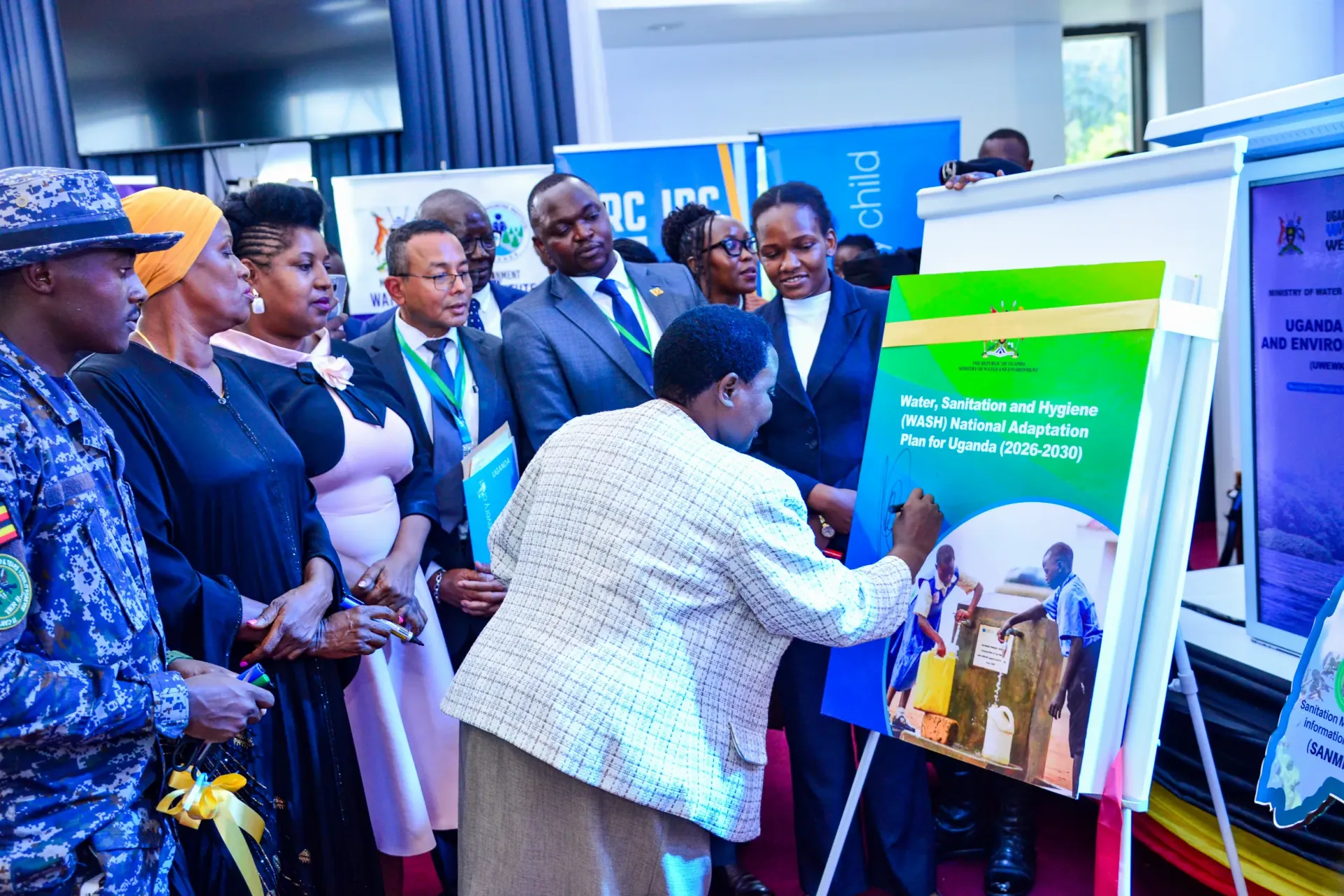
During the 9th Uganda Water and Environment Week, the government officially launched the Water, Sanitation and Hygiene National Adaptation Plan (WASH-NAP), the first climate adaptation plan of its kind globally developed with support from UNICEF.
Prime Minister, Robinah Nabbanja, while launching the plan said it would guide all sectors, government ministries and agencies and stakeholders on how to address climate change impacts related to water, sanitation and hygiene infrastructure and service delivery systems.
The five-year roadmap, developed through extensive nationwide consultation, provides a comprehensive response to the climate threats facing Uganda’s WASH sector.
According to the sector vulnerability assessment, over three-quarters of boreholes, valley dams and rainwater harvesting tanks are exposed to drought. Half of all shallow wells and protected springs risk running dry during prolonged dry spells.
Dr Alfred Okot Okidi, the permanent secretary, Ministry of Water and Environment, highlighted that the WASH – NAP was developed to provide a roadmap to reducing climate risk vulnerabilities by integrating adaptation measures to Water, Sanitation and Hygiene infrastructure and service delivery systems.
“I extend my profound gratitude to UNICEF for supporting us to not only launch the WASH-NAP but also be the first to do so, globally,” Okidi said.
The plan recognises that climate change is fundamentally a water crisis.
When drought hits, a borehole does not just dry up, a girl drops out of school because she must walk long distances in search of water. When floods contaminate sources, young children face the highest risk of disease.
Implementation will require an estimated Shs 993 billion ($276 million) over five years. Fund will cover most aspects from enabling environments to catchment management interventions and the additional costs needed to make WASH infrastructure climate resilient.
Dr Robin Nandy, the UNICEF Representative to Uganda, emphasised the plan’s significance at the launch.
“This is not just a document, but a living guide for every district in this country,” he said.
He said the plan’s development was inclusive and involved stakeholders from national ministries to local catchment committees.
For Daniel in Kotido and thousands like him, the WASH-NAP represents hope.
Hope that, boreholes designed to withstand drought, protected springs that will not collapse in landslides, flood-resistant sanitation systems and reliable water access that keeps children in school and families healthy.