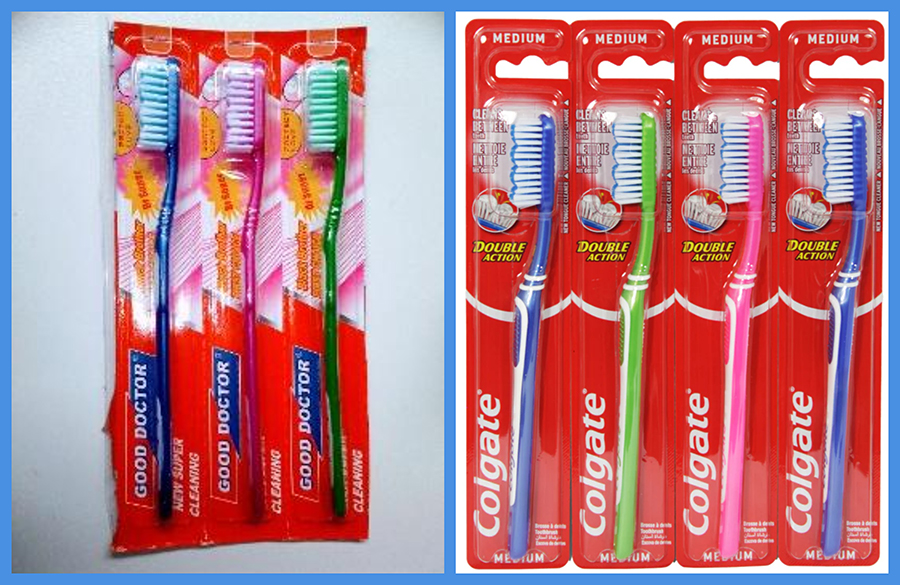
What is the difference between the packaging and appearance of a Colgate toothbrush and that of Good Doctor?
Well, for many, there aren’t any.
A trademark dispute between Colgate-Palmolive Company and a Chinese applicant, Bi Wang, the makers of Good Doctor toothbrushes, has exposed serious procedural errors at the Uganda Registration Services Bureau (URSB) that led to the registration of the Good Doctor trademark.
The Good Doctor trademark has finally been cancelled, and in a ruling, the assistant registrar of trademarks, Denis Birungi, described its registration as illegal, null, and void from the start.
The dispute started on July 8, 2024, when Bi Wang, a Chinese national, applied to register the trademark “AFDBT GOOD DOCTOR”. The application covered everyday items such as toothbrushes, electric toothbrushes, dental floss, cheek brushes, toothpicks, soap boxes, and other bathroom and cleaning utensils.
Under Uganda’s trademark law, such applications are published to allow other parties to object if they believe the proposed mark conflicts with their existing rights. Colgate, which owns well-known dental care brands and several registered trademarks in Uganda, took notice.
On December 19, 2024, Colgate formally opposed Bi Wang’s application. The company argued that the “GOOD DOCTOR” mark was confusingly similar to its own registered trademarks, numbers 59257 and 64262, which were registered in 2017 and 2019, respectively.
Once an opposition is filed, the law is clear. The registrar must notify the applicant, who then has 42 days to file a counterstatement explaining why the trademark should still be registered. If the applicant does not respond, the law treats the application as abandoned.
In this case, the bureau transmitted the opposition to Bi Wang’s lawyers, Sipi Law Associates, in February 2025 and asked for a counterstatement. By the time the deadline expired on March 31, 2025, no response had been filed.
Twist
Despite the pending opposition and the absence of a counterstatement, the trademark office went ahead and registered Bi Wang’s trademark on January 23, 2025. A certificate of registration was issued on February 6, 2025.
Armed with that certificate, Bi Wang’s lawyers took a firm position. They declined to file any counterstatement, arguing that since the trademark had been registered, opposition proceedings had automatically terminated.
Colgate strongly disagreed. Its lawyers wrote to the registrar in June 2025 asking that the matter be fixed for a hearing. Shortly after, Bi Wang’s lawyers withdrew from representing him, leaving him without legal representation.
The hearing went ahead in September 2025 with only Colgate represented. Its lawyer, Brian Kajubi of MMAKs Advocates, argued that the registration was unlawful because the Trademarks Act does not allow registration while an opposition is unresolved.
Fine Art lecturer at Makerere to face internal probe for “making female student uncomfortable”
Birungi, the assistant registrar, agreed that the key issue was whether the premature registration should be reversed to allow the opposition to be properly heard.
In his ruling, Birungi carefully walked through the law. He cited section 16 of the Trademarks Act, which states that registration can only happen if no objection has been filed within time or if an objection has been decided in favour of the applicant.
“None of the two requirements under section 16 (1) were satisfied in the present case,” he said.
Birungi compared the registration to a football offence commonly known as “offside”.
“To use a football analogy, this registration is akin to an offside goal. An offside goal is disallowed because an attacker is in an illegal offside position and scored because of the unfair advantage accorded to him by that position,” he said.
The registrar rejected the idea that the mere issuance of a certificate could wipe away an opposition. He stressed that opposition proceedings exist to protect prior rights, maintain an accurate register, and serve the public interest.
The ruling was a clear win for Colgate. Birungi declared that the registration of Bi Wang’s trademark was illegal and “null and void ab initio,” meaning it had no legal effect from the beginning.
He ordered that the trademark be cancelled and expunged from the register and that the process be reversed to the application stage so that Colgate’s opposition can now be heard and determined on its merits.
“This would not only be unfair to the opponent, but would also delay administration of justice on mere technicalities,” he said.