President Museveni has instructed newly elected Uganda People’s Defence Forces (UPDF) representatives to Parliament to serve primarily as “observation posts”.
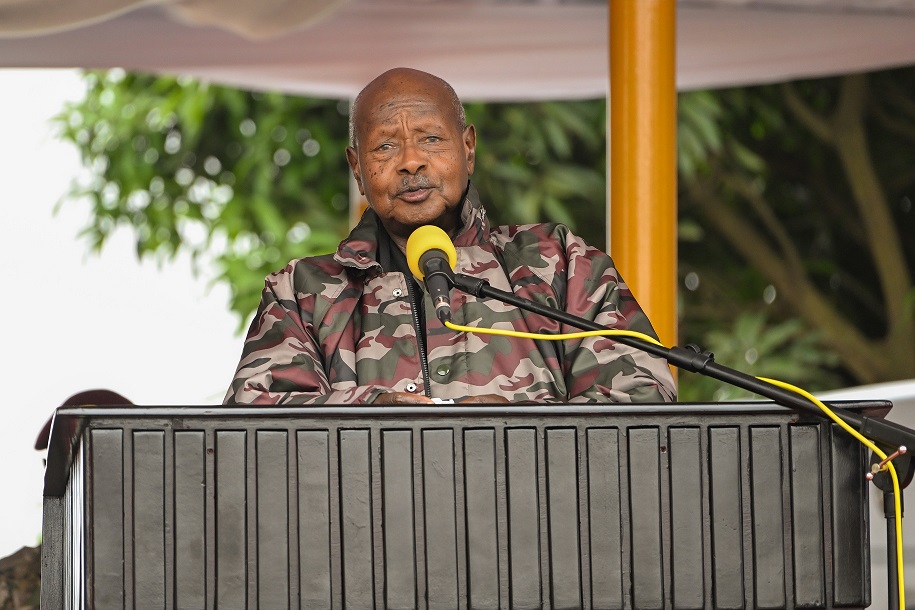
Museveni, who is also commander-in-chief of the UPDF, made the remarks on Tuesday while presiding over the election of UPDF representatives to the 12th Parliament at the Land Forces headquarters in Bombo.
During the Defence Council Delegates Conference, officers elected 10 representatives, seven men and three women, to sit in Parliament.
The male representatives include; Lt. Gen. Sam Okiding, Lt. Gen. James Mugira, Lt. Gen. Sam Kavuma, Brig. Gen. Gonyi David, Maj. Gen.Henry Masiko, Maj. Gen. James Kinalwa and Brig. Gen. Joseph Ssemwanga.
The female representatives are; Col. Ikiriza Knight, Col. Meeme Sylvia and Col. Nekesa Christine Situma.
Addressing the officers, Museveni said the role of UPDF MPs is to observe developments within government and Parliament, identify emerging national problems early and report them to the army leadership so that corrective action can be taken before policy mistakes deepen.
He said UPDF representatives function as early warning mechanisms within the legislature, rather than as conventional legislators.
“They are not there to argue like politicians but to see what is going on and report,” Museveni said, explaining that their presence in Parliament is meant to safeguard national interests by ensuring that dangerous or misguided decisions are detected in time.
Museveni cited the decision by MPs to increase their salaries as an example of a policy matter that, in his view, should have been flagged early and addressed through internal state mechanisms.
The president’s remarks underline the unique position of UPDF MPs, who are appointed under Article 208 of the Constitution. Their mandate, Museveni said, is informational rather than political.
He tasked the newly elected officers to closely monitor the implementation of key government programmes, including the Parish Development Model, free education, road construction and immunisation campaigns.
While acknowledging improvements in preventive healthcare, Museveni said curative services still face serious challenges that require close attention.
The president reiterated that the guiding philosophy of the National Resistance Movement since the 1960s has been identifying and solving people’s practical needs.
He referred to the Runyankore concept of “okukyenura”, which he described as the deliberate identification and resolution of real-life problems affecting citizens.
Museveni reflected on the NRM’s early years in power, saying that by 1996 the Movement had restored discipline in the army, rejected sectarian politics, eliminated shortages of essential commodities, rebuilt infrastructure and rolled out immunisation against six killer diseases. These achievements, he said, earned the NRM broad public support.
On electoral governance, Museveni repeated his position that Ugandans must be allowed to choose their leaders through one person, one vote by secret ballot.
He said irregularities in the 2021 general elections, including what he described as the infiltration of about 2.7 million votes, informed his push for biometric verification, although he noted that the technology had not been fully utilised.
The chairperson of the Electoral Commission, Justice Simon Byabakama, praised UPDF officers for maintaining discipline during the voting process and urged stakeholders to embrace unity as the election season ends.