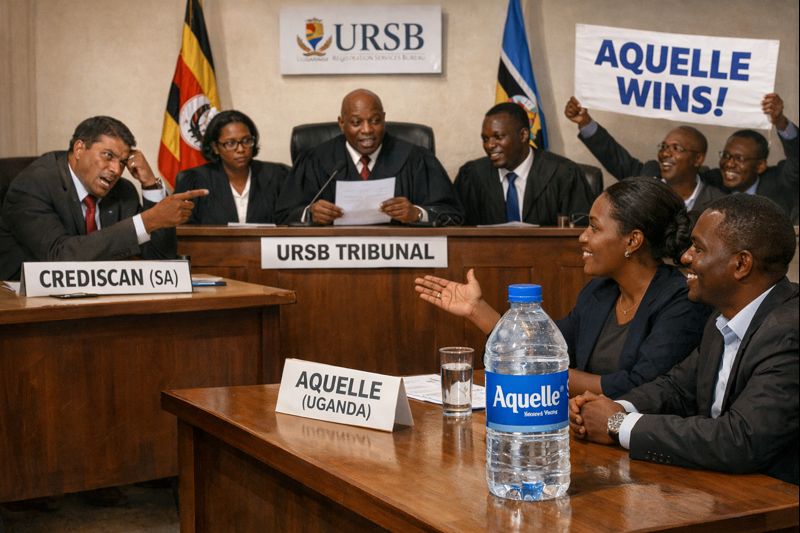
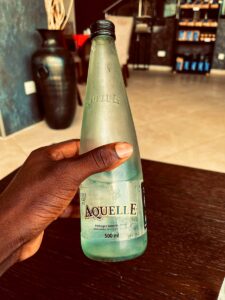
Those of you who have gone to an upscale hotel in Kampala, like Serena Hotel, will have noticed that they now serve Aquelle Mineral Water brand to conference guests.
Well, a South African firm, Credscan, claimed that “Aquelle” is its trademark and that Aquelle Beverages, the Ugandan company that makes the water, had infringed on its trademark.
So it took the Ugandan company to the Uganda Registration Services Bureau (URSB) tribunal, seeking to have its trademark cancelled.
Note that Credscan, which is based in KwaZulu-Natal, is in the business of offering management consultancy services, not mineral water. Still, it argued that it had registered the “Aquelle” trademark in 1998.
However, in the tribunal, things did not go as planned because URSB dismissed its application, saying that Aquelle Beverages had lawfully secured the mark and did not act in bad faith.
Mark Tugume, the assistant registrar for Trademarks at URSB, who heard the dispute, observed that Aquelle Beverages’ registration of the trademark “Aquelle” for bottled and mineral water products was neither made in error nor obtained dishonestly, as alleged by Credscan.
The dispute arose from the registration of trademark number UG/T/2023/080314, “AQUELLE”, which Aquelle Beverages, based in Kampala’s industrial area, secured in August 2023. The trademark covers mineral water, aerated water, and other non-alcoholic beverages.
Credscan, based in KwaZulu-Natal, applied in November 2024 to have the Ugandan trademark cancelled. It argued that it was the true owner of the name “AQUELLÉ”, which it said it had used internationally since 1998 and registered in several countries, including South Africa.
Credscan claimed that Aquelle Beverages’ mark could not properly distinguish the Ugandan company’s products from its own. It also accused Aquelle Beverages of acting in bad faith, arguing that the company deliberately copied a well-known international brand to deceive consumers and benefit from Credscan’s reputation.
In response, Aquelle Beverages denied any wrongdoing. It said it followed the correct legal process under Uganda’s trademark law and that there was no competing “Aquelle” mark on the Ugandan register at the time of its application.
The company also argued that Credscan had failed to oppose the trademark during the publication stage, despite being granted extra time to do so.
But Credscan’s lawyer, Kerim Epaphiaditus Clyde of Matsiko, Wanda & Arinda Advocates, argued that the registrar should recognise its earlier international use and registrations.
He told the bureau that “AQUELLÉ” had built global goodwill and that online presence and international reputation should be enough to establish prior rights, even without registration in Uganda.
He further submitted that Aquelle Beverages “must have been aware of the notoriety of the Credscan trademark and business” and adopted the mark to “ride on the goodwill and reputation” of the South African Firm.
Aquelle Beverages’ lawyer, Dinnah Kyasimiire of SIPI Law Associates, took a different view. She argued that trademark rights are territorial and that foreign registrations do not automatically give protection in Uganda.
She said Uganda operates a first-to-file system and that Aquelle Beverages was the first to apply locally. She also told the registrar that Credscan had no market presence in Uganda and therefore no local goodwill capable of protection.
Tycoon Ssebalamu wins Shs 550 million from gov’t over Rubaga land dispute
In his ruling, Tugume first addressed whether the trademark was registered in error. He noted that the Trademarks Act does not define the word “error” and turned to its ordinary meaning.
He wrote that a registration is erroneous only if it was made in breach of the law or without complying with statutory requirements.
He found that this was not the case.
“At the time the Respondent’s application was examined and accepted by the Registrar, the Applicant’s mark was not on the Ugandan register,” Tugume said.
“Therefore, the Registrar could not have entered the trademark in error, as there was no conflicting mark on the register to cite against it.”
Tugume emphasised that Uganda follows a first-to-file system, meaning priority goes to the party that applies first, not the one that first used the mark elsewhere. He added that international reputation alone does not override this system unless specific legal steps are taken.
On Credscan’s reliance on the Paris Convention and its argument that “AQUELLÉ” was a well-known mark, Tugume was clear.
“Trademark protection is territorial,” he said, adding that protection for well-known foreign marks in Uganda is strictly governed by statute. He noted that Credscan had not applied for defensive registration under Ugandan law before Aquelle Beverages secured its trademark.
The registrar then turned to the allegation of bad faith. He said the burden of proof starts with the person alleging bad faith. He found that Credscan had failed to show that Aquelle Beverages knew about its brand or intended to undermine its interests when it applied for registration.
He accepted Aquelle Beverages’ explanation that the mark originated from its Kenyan affiliate, which had used the name since 2005 and registered it in Kenya in 2019, before expanding into Uganda.
Tugume also contrasted the parties’ market presence. He said Credscan had only shown international reputation and online visibility, which was not enough.
“Having a mere reputation is like being known in a country. But if there is no commercial conduit for consumers to purchase your product locally, then you have reputation, not local goodwill,” Tugume ruled.
In the end, he dismissed Credscan’s application in its entirety.
“The Applicant (Credscan) has failed to establish that Aquelle Beverages’ trademark was registered in error or in bad faith,” Tugume ruled.