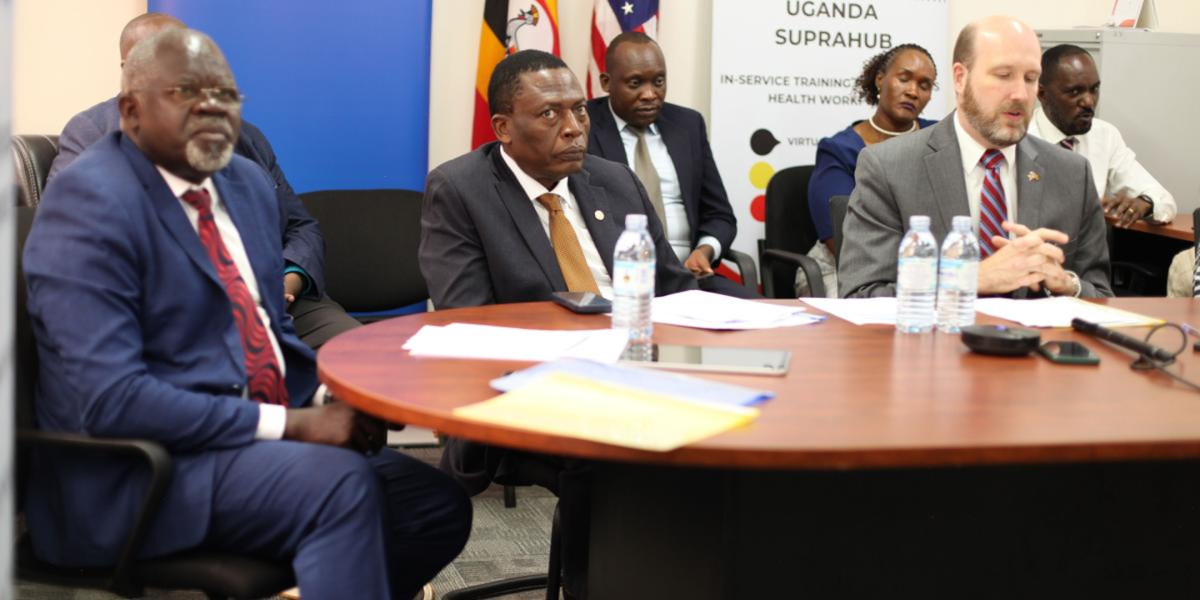
Health workers in more than 17 government referral hospitals in Uganda are set to receive training in coordination, strategy and capacity building through virtual technology as part of efforts to close the skills gap in the health sector.
Speaking at the launch of the Supra Hub programme at the ministry of Health headquarters, William W. Popp, the US ambassador to Uganda, reaffirmed his government’s commitment to supporting Uganda’s vulnerable health system.
“As we launch this model that originated from the University of New Mexico, I would love to see other countries like Uganda adopt this kind of model because it is cost effective and life saving in the dissemination of knowledge, especially during outbreaks,” Popp said.
He explained that the use of virtual technology will allow experts to replicate subject matter, make specialist knowledge accessible in real time to hard to reach areas and create a network of health workers who can learn from one another.
Dr Charles Olaro, the Director General of Health Services, commended the US government for driving innovation in knowledge sharing, coordination and strategy in areas such as HIV and Aids, mental health, laboratory sciences, emergency medicine, surveillance and pharmacy.
He said the introduction of the Supra Hub model will help change the status quo in Uganda’s health sector by closing gaps in skills and efficiency and improving life saving interventions.
Olaro said the model will support mentorship that aligns with Uganda’s health priorities. These include primary health care, disease prevention and health promotion, all aimed at improving the population’s overall wellbeing.
“This will help us expand and adapt to the country’s evolving environment, which is in high demand for new technologies in the treatment and prevention of emergency outbreaks, communicable and non communicable diseases,” Olaro said.
He also praised the partnership between the ministry of Health, the US government and Jhpiego, the implementing partner, saying the initiative is expected to go beyond the initial 17 referral hospitals. It will offer a unified and standardised curriculum linking district health centres III and IV and hospitals in Kisoro, Kotido and Arua, among others.
On concerns about the welfare of health workers, Olaro urged medics to remain committed to their patients. He said the government remains the best employer and offers better pay than most private facilities. He also noted that health workers have opportunities to study while working and that the government is committed to increasing training and professional development.
Isaac Mukama, the programme manager at Jhpiego, said the SupraHub model consists of telementoring equipment that includes a smart television, computer, teleconferencing camera, speaker and IT accessories for connectivity.
Mukama revealed that more than 450 sites have already been equipped with telementoring tools. The model focuses on training regional hubs at health centres III and IV, while facilities below these levels act as spokes in the system.
He said virtual platforms such as Zoom, Telegram, Microsoft Teams and other social media channels will be used for continuous discussion, telementoring and teletraining.